


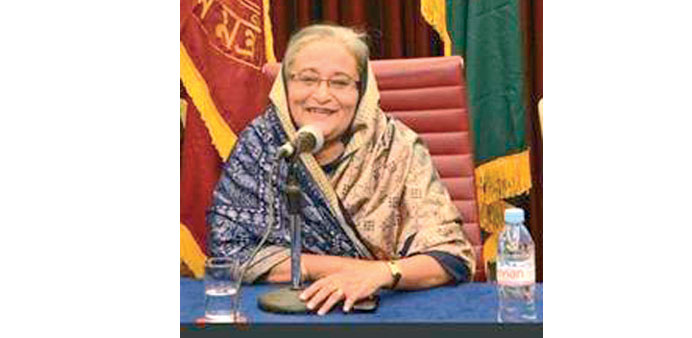
Bangladesh Prime Minister Sheikh Hasina addressing a meeting of expatriate Bangladeshis in London at a hotel late on Friday.
Agencies/Dhaka
Bangladesh Prime Minister Sheikh Hasina has asked Khaleda Zia to sue a US daily after the main opposition leader disowned an article published in her name in the paper seeking sanctions against Dhaka to save democracy.
The controversial article, published in The Washington Times, which sought US sanctions against Bangladesh, sparked a political row in the country.
“Why don’t you (Zia) sue The Washington Times if the signature is really fake?” she said while addressing a meeting of expatriate Bangladeshis living in Britain and other European countries at a hotel in London on Friday.
Hasina also questioned how the US newspaper could show “such an audacity by publishing the article in the name of Khaleda Zia if she did not write it at all”. Zia disowned the write-up while the newspaper insisted it was authored by her only.
The article was published on January 30 under a title ZIA: The thankless role in saving democracy in Bangladesh, but the controversy over the write-up began last week when the United States scrapped Bangladesh’s preferential trading status over workers’ rights and safety issues.
She said front-ranking BNP leaders are claiming the write-up was published using a faked signature of Zia. “But initially, senior BNP leaders made comments in favour of the article, projecting its justification, though they are denying it,” Hasina said.
Hasina alleged that Zia tarnished Bangladesh’s image by asking the US government to impose economic sanctions on Bangladesh, reported the private UNB news agency.
The PM alleged Zia and her party now disowned the article to “escape blames” for the US suspension of generalised system of preferences (GSP) for Bangladeshi products.
She urged expatriate Bangladeshis to contact the London-based public relation firm BTP, which pursued The Washington Times to publish Zia’s article, to confirm this.
Alleging militancy, terrorism and corruption by the BNP-Jamaat parties during their rule, Hasina said the country’s image would be tarnished again if they returned to power.
She claimed the present government had revived the country’s image after assuming office by containing terrorism and militancy with an iron hand, and implementing development
programmes.
In addition, she claimed the government ensured food and social security of people, as well as minimised public suffering to a great extent by generating more electricity. “No government other than Awami League could carry out such developments in the past.”
The prime minister asked the expatriate Bangladeshis to project the successes of the government in various fields ahead of the next general election.