


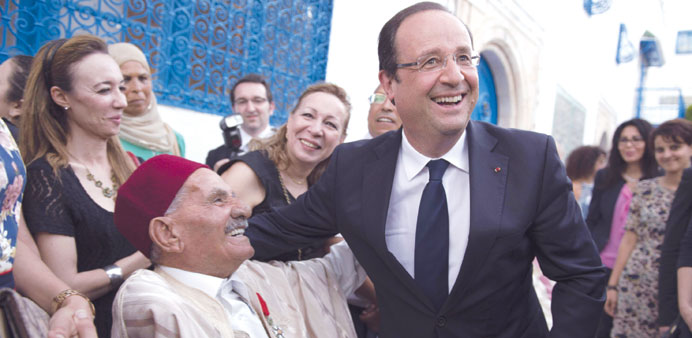
Agencies/Tunis
France’s president told Islamist-led Tunisia yesterday it was heading in the right direction, drawing a positive contrast with countries like Libya and Egypt.
President Francois Hollande said Paris would provide 500mn euros ($645mn) in loans and grants to support the North African state. Sixty million euros of Tunisian debt would also be converted into investment projects.
Tunisia’s democratic transition was “a model in the region”, Hollande said.
“You are heading in the right direction. In Libya the transition has been tainted by violence; in Egypt the transition was stopped after the removal of the elected president; and in Syria, desire for change led to war,” he added.
Hollande said Islam and democracy were “on the same path” and France would not impose lessons on its former colony.
Hollande is on the first visit to Tunisia by a French head of state since the 2011 revolution that toppled President Zine al-Abidine Ben Ali and launched Arab Spring uprisings across the region.
In a speech to parliament yesterday, Hollande said he wished to “learn the lessons of the past” and recognised the “wounds” in the French-Tunisian relationship dating, notably, to the time of the 2011 revolution.
Relations were damaged by the close ties that his predecessor Nicolas Sarkozy fostered with Ben Ali.
Ministers in Sarkozy’s administration sparked anger in Tunisia by failing to immediately back the uprising.
Just days before Ben Ali fled, then foreign minister Michele Alliot-Marie shocked Tunisian democrats by suggesting France could help train Tunisia’s hated security forces to help them better control the protests.
The visiting French president also addressed outstanding issues relating to the colonial past, announcing a symbolic opening of French archives on the assassination of nationalist leader Farhat Hached, whose tomb he visited.
“To rebuild our relationship we must first confront the truth,” he said.
Hached’s death in 1952, four years before Tunisia’s independence, is blamed on a paramilitary organisation active under the French protectorate.
With its historical ties and investments, France remains Tunisia’s first economic and trade partner.
Hollande told business leaders from both countries that by supporting the economy they were assisting the democratic transition in Tunisia, which has been plagued by social unrest linked to unemployment and poor living conditions, and which has also put pressure on the key tourism sector.
“The French development agency will invest particularly in the rehabilitation of poor neighbourhoods, the supply of drinking water, professional training, improving rail links and agricultural development,” he said.