


Agencies/Addis Ababa
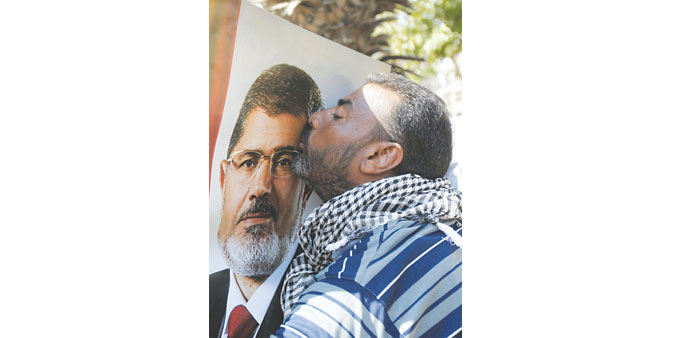
The African Union voted overwhelmingly yesterday to suspend Egypt from all its activities after the Egyptian army ousted the elected president, Mohamed Mursi, following days of mass protests against his rule.
Egypt expressed “deep regret” over the suspension.
Cairo “profoundly regrets the decision of the African Union peace and security council to suspend our participation in the organisation’s activities”, the foreign ministry said in a statement on its official Facebook page.
Suspension is the AU’s usual response to any interruption of constitutional rule by a member state and it is generally lifted once a country has held a free election once again, which is the Egyptian army’s stated goal, though it has given no timeframe.
“As mandated by the relevant AU instruments, the African Union Peace and Security Council decides to suspend the participation of Egypt in AU activities until the restoration of constitutional order,” said council secretary Admore Kambudzi.
Egypt is one of the biggest contributors to the AU budget and its suspension will freeze it out of joint decision-making.
AU Commission chief Nkosazana Dlamini-Zuma, speaking to reporters after the decision, said Egypt would be suspended “until there is an election, which would obviously be the expression of the will of Egyptian people”.
But she also offered AU support to “the Egyptian people for a better life” and said that “the sooner they can come back, the better for all of us.”
However, Mohamed Edrees, Egyptian ambassador to the AU, said ahead of the decision that “the voice and the call of tens of millions of Egyptians must be heard, understood and respected”.
In March the AU suspended the Central African Republic after rebels overthrew the government. It meted out similar treatment previously to Madagascar and Mali but in all cases cited only a change of power by “unconstitutional means” as the offence, not a “coup”. Mali’s suspension was later lifted.
Diplomats said suspension is applied over “unconstitutional means” of power transition regardless of the size and influence of any African country. Egypt is the Arab world’s most populous nation and among the bigger economies on the African continent.
“We have laws and it was clear from the beginning - it was an unconstitutional change of government,” a West African diplomat who declined to be named said. “Such changes are a violation of the AU’s constitutive act.”
But a diplomat from North Africa criticised the AU’s automatic response to Egypt’s case.
“It’s a pity. They have to revisit this law,” he said. “These are different types of situations and they (AU) are turning a blind eye to the aspirations of people.”
The Egyptian military removed Mursi after millions of Egyptians rallied in protest at a crumbling economy and what they saw as his effort to turn the state into a fief of the Muslim Brotherhood despite a limited electoral mandate.
The AU said it would soon send a team of “eminent personalities” - including Nigerian ex-president Olusegun Obasanjo, according to one official - as observers to Egypt to encourage moves back to electoral democracy.
After the swearing-in of constitutional court chief judge Adli Mansour on Thursday as interim head of state, the next step in the Egyptian army’s proclaimed “road map” back to democracy is the formation of an interim government in the coming days.
Tunisia and Turkey, both governed by Islamists, were among Muslim countries to denounce Mursi’s overthrow expressly as a coup. The US and European Union sidestepped that description, which would automatically trigger punitive sanctions, but called for a swift return to democratic rule.