


|
|
Sri Lanka will hold provincial elections in the former northern war zone in September for the first time in 25 years, officials said yesterday, a move demanded by the United Nations since the end of three decades of conflict in 2009.
But Northern Province, which includes the Jaffna peninsula, has been under military control since the end of the war and the government had resisted requests by the West to pull out the army.
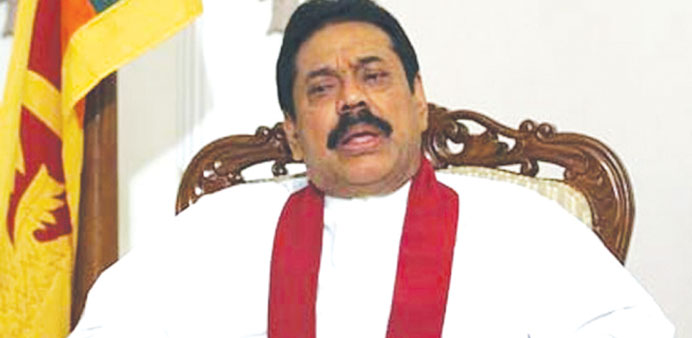
Ariyaratne Athugala, director general of the department of government information, said President Mahinda Rajapakse had issued the proclamation to hold northern provincial
council polls.
The elections commission said they would probably be held on September 21 or 28.
Elections commissioner Mahinda Deshapriya had said last month that elections for the Northern Provincial can take place only after September 14.
Meanwhile the governors of the Central and North Western provinces said they have also been informed to dissolve their respective provinces for
elections to be held.
The governor of the Central Province, Tikiri Kobbekaduwa, and the governor of the North Western Province, Thisa R Balala, said their respective provincial councils will be dissolved with effect from Saturday.
Sri Lanka has repeatedly rejected calls for an independent, international probe into accusation of rights abuses in the final stages of the war. Tens of thousands of civilians, mostly Tamils, were killed in the final months, according to a
UN panel.
A court on Thursday ordered that 12 elite police commandos, suspects in the killing of five Tamil students during the war, be placed again in detention.
They had been released in 2007 after more than two months in detention after legal authorities said there was no evidence to launch proceedings against them.
The UN Human Rights Council in March urged Sri Lanka to carry out credible investigations into killings and disappearances. The UN High Commissioner for Human Rights, Navi Pillay, is to visit Sri Lanka in August.
The government has said a military presence is necessary in the north to prevent the re-emergence of terrorism three years after it crushed the Liberation Tigers of Tamil Eelam (LTTE).
Successive governments did not hold provincial polls in the north because most of the territory was under LTTE control.
Sri Lanka introduced provincial councils in 1987 with a constitutional amendment aiming to ensure regional autonomy mainly for the island nation’s north and east where the LTTE had fought to create an independent state for Tamils.
The constitutional amendment, which gives autonomy to provincial councils including powers over police and land, has yet to be fully implemented.
Meanwhile, a top Sri Lankan government minister has played down intensified diplomatic engagement with India over power devolution to its Tamil minority and insisted that it was merely to keep the regional super power “informed.” Economic Development Minister Basil Rajapakse who is also President Mahinda Rajapakse’s brother flew to New Delhi to meet with top officials including Indian Prime Minister Manmohan Singh to explain the government’s plans on power devolution to the Tamil minority, said Cabinet spokesman and Media Minister Keheliya Rambukwella.
The move came after Singh expressed “dismay” over the Sri Lankan government’s plans to roll back power devolution under the 13th Amendment to its constitution, which was made with the intervention of India in 1989.
After Sri Lanka ended a brutal three-decade war with the Liberation Tamil Tigers of Eelam (LTTE) in 2009, President Rajapakse pledged to the United Nations and India that a political solution would be found by implementing the 13th Amendment.
However, despite the lapse of more than four years the Sri Lankan government has failed to deliver on those promises.
Last month the government appointed a Parliamentary Select Committee (PSC) which has been tasked with finding a political solution to the ethnic crisis, but the main Tamil party, the Tamil National Alliance and the opposition have refused to take part in it.
Rambukwella acknowledged that the government was keen to revamp land and police powers under the 13th Amendment but insisted the interaction with
India was merely a “courtesy.”