


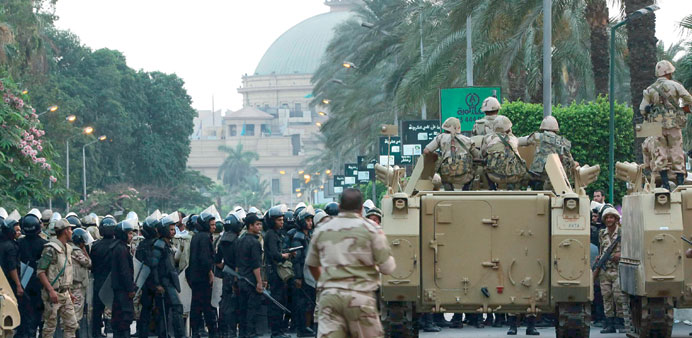
A huge presence of Egyptian army soldiers and anti-riot policemen is seen as supporters of ousted Egyptian president Mohamed Mursi protest near Cairo University yesterday. Adly Mansour, the chief of Egypt’s highest court, was sworn in as the nation’s interim president.
AFP/Cairo
Egypt’s army rounded up the leadership of ousted president Mohamed Mursi’s Muslim Brotherhood yesterday as a top judge took office after an abrupt end to the Islamist’s first year in power.
Mursi’s government unravelled late on Wednesday after the army gave him a 48-hour ultimatum in the wake of massive demonstrations since June 30 against his turbulent rule.
The Brotherhood called for a peaceful protest today over the “military coup” as the army turned the screws on the Islamist movement.
Its supreme leader Mohamed Badie was arrested “for inciting the killing of protesters”, a security official told AFP.
Anger gave way to gloom as thousands of the embattled Islamist movement’s supporters rallied at a Cairo mosque, surrounded by the army.
“It’s a soft military coup. The military was smart, using the cover of civilians,” said one, 26-year-old Ahmed al-Sayyed, in reference to the mass anti-Mursi protests.
Military chief General Abdel Fattah al-Sisi announced Mursi’s overthrow on Wednesday night, citing his inability to end a deepening political crisis, as dozens of armoured personnel carriers streamed onto Cairo’s streets.
The crackdown came as chief justice Adly Mansour, 67, was sworn in as interim president at a ceremony broadcast live from the Supreme Constitutional Court.
He will serve until elections at a yet-to-be determined date, said Sisi, as he laid out a roadmap for a political transition that includes a freeze on the Islamist-drafted constitution.
A judicial source said the prosecution would on Monday begin questioning Brotherhood members, including Mursi, for “insulting the judiciary”.
Other leaders of the movement would be questioned on the same charges, including the head of its political arm Saad al-Katatni, Mohamed al-Beltagui, Gamal Gibril and Taher Abdel Mohsen.
Mursi and 35 other Brotherhood leaders have also been slapped with a travel ban. Analysts said Mursi and his Islamists hastened their own demise.
“Mursi and the Brotherhood made almost every conceivable mistake... they alienated potential allies, ignored rising discontent, (and) focused more on consolidating their rule than on using what tools they did have,” Nathan Brown wrote on the New Republican website.
A senior military officer said the army was “preventively” holding Mursi and that he might face formal charges linked to his prison escape during the revolt that overthrew dictator Hosni Mubarak in 2011.
Mursi had issued a defiant call for supporters to protect his elected “legitimacy”, in a recorded speech hours after the military announced his ouster.
“We had to confront it at some point, this threatening rhetoric,” the officer said. “He succeeded in creating enmity between Egyptians.”
Mursi’s rule was marked by a spiralling economic crisis, shortages of fuel and often deadly opposition protests.
Thousands of protesters dispersed after celebrating wildly through the night at the news of his downfall.
Egypt’s press almost unanimously hailed Mursi’s ouster as a “legitimate” revolution.
“And the people’s revolution was victorious,” read the front page of state-owned Al-Akhbar.
Mursi’s opponents had accused him of failing the 2011 revolution by concentrating power in Brotherhood hands.
His supporters say he inherited many problems from a corrupt regime, and that he should have been allowed to serve out his term until 2016.
US President Barack Obama said he was “deeply concerned” over Mursi’s ouster and urged the army to refrain from “arbitrary arrests”.
In May, Washington approved $1.3bn in military aid to Egypt. That was now under review, said Obama, as he called for a swift return to democratic rule.
Germany called the military’s move “a major setback for democracy in Egypt”, while UN chief Ban Ki-moon said civilian rule should resume as soon as possible.
Governments across the Middle East welcomed Mursi’s ouster with varying degrees, with war-hit Syria calling it a “great achievement”.
At least 10 people were killed in clashes in Alexandria and in the southern province of Minya during the night, security officials said, after the week before Mursi’s downfall saw at least 50 dead.
Emir, PM congratulate Egypt’s interim leader
HH the Emir Sheikh Tamim bin Hamad al-Thani yesterday sent a cable of congratulations to Egypt’s chief justice Adly Mansour on the occasion of his taking the oath as an interim president of the country. HE the Prime Minister and Interior Minister Sheikh Abdullah bin Nasser bin Khalifa al-Thani also sent a cable of congratulations to Mansour.