


|
India has asked the World Bank and the Asian Development Bank for financial assistance to help rebuild roads and bridges after flash floods and landslides devastated Uttarakhand, a government statement said. |
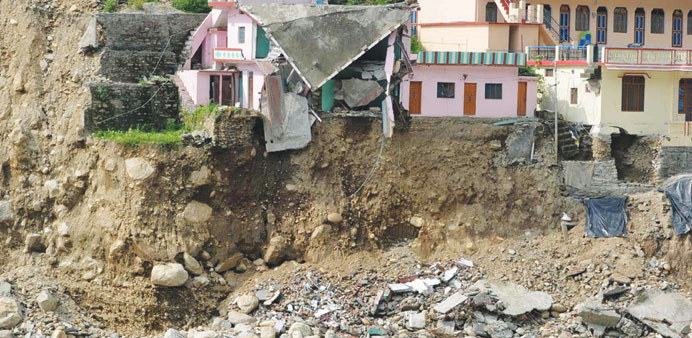
Heavy monsoon rains caused rivers and lakes in the Himalayan state to burst their banks more than two weeks ago, sending torrents of water crashing through the mountainous area, a popular Hindu pilgrimage destination. At least 580 people have died and more than 3,000 are still missing.
“The state of Uttarakhand has suffered extensive damage to physical infrastructure like roads, bridges, embankments, public buildings, houses etc due to the recent heavy rains, flash floods and landslides,” a finance ministry statement said.
“The task of reconstruction and rebuilding the infrastructure would require huge quantum of funds.”
The government has decided to seek external help from multilateral banks like the World Bank and the ADB for reconstruction, the statement added, without saying how much India required or whether it wanted loans, grants or both.
World Bank officials confirmed that a team of experts, comprising Indian government, World Bank and ADB officials, would visit the region to assess the damage and examine proposals for reconstruction projects.
India is the World Bank’s largest client, receiving $3bn to $5bn annually in loans and grants to fund development projects in a country where one-third of the population - around 400mn people - lives on less than $1.25 a day.
There is no official figure for the overall economic loss caused by the floods, but aid workers in the disaster zone estimate stretches of around 1,650 roads have been damaged, including state and national highways.
Around 150 bridges, over 2,000 houses and around 1,000 drinking water sources have been destroyed or damaged, they say, adding that hundreds of villages’ electricity and telecommunications services have been cut.
The tourism and services sector, a mainstay of the local economy, has been decimated and will need long-term support, experts say.
The popular pilgrimage route known as the “Char Dham Yatra” because of its four temple towns of Kedarnath, Badrinath, Gangotri and Yamunotri - attracting hundreds of thousands of devotees every year - is unlikely to open within the next year.
Many hotels, restaurants, shops and other businesses built near river banks were swept away or damaged in the deluge.
A survey by the PHD Chamber of Commerce and Industry estimated that the tourism industry alone had suffered losses of around Rs120bn.
Meanwhile, Minister for Culture Chandresh Kumari Katoch said “outside help” was not required to restore the 11th century Kedarnath temple.
“We want to restore the temple to its original glory and we have the best experts. It should be left to the department (Archaeological Survey of India),” Katoch said.
“Others should not interfere,” she added.
The minister was replying to a question whether the central government would accept Gujarat Chief Minister Narendra Modi’s offer to help rebuild the temple.
Katoch said the ministry had sent a team of experts to assess the damage to the temple. However, they could not reach Kedarnath due to the weather.
Asked about the funding needed to rebuild the temple, she said the ASI will seek funds from the central government, the National Culture Fund and also raise money through public participation.
“The state government can also contribute,” she said.