


|
The ruling Congress Party said yesterday a vast new food scheme for the poor was a “game-changer” to fight endemic malnutrition, but analysts expressed concern about the programme’s implementation and cost. |
The cabinet issued an executive order late Wednesday introducing the National Food Security Bill, which is expected to be approved by the president and be a vote-winning measure ahead of elections next year.
The populist programme - which the government says will add Rs230bn ($3.8bn) per year to the country’s existing Rs900bn food subsidy bill - will offer subsidised grains to an estimated 810mn people.
It has been pushed strongly by the Congress chief Sonia Gandhi, who has insisted on honouring a 2009 election pledge despite concerns about the impact on government finances and food prices.
“It is going to be a game-changer in terms of poverty eradication,” senior Congress leader Tom Vadukkan said. “If basic needs like hunger are not met, you can’t talk about (economic) development.”
Despite two decades of strong economic growth, India still struggles to feed its population adequately, with a major survey last year showing that 42% of children under five were underweight.
The food measure, which will offer 5kg per person per month for as little as one rupee per kg, is considered key to the Congress-led coalition’s fortunes in the national elections due in 2014.
“If it wins us votes, then that is an after-thought,” Vadukkan, also a party spokesman, claimed. “Naturally anything good that you do gains you popularity.”
The opposition parties have rounded on the government for ramming through a controversial programme without a parliamentary debate, but the executive order is only temporary and must be converted into law.
It will be introduced later this month or in August in the next session of parliament, which has been stalled for much of the last two years due to repeated protests by the opposition.
“It is just a political gimmick in a hurry,” the opposition Bharatiya Janata Party (BJP) president Rajnath Singh told reporters yesterday.
Critics of the food programme say that India can ill-afford such a costly subsidy burden at a time of slowing economic growth and when credit ratings agencies are eyeing the country’s large deficit.
“India’s current macroeconomic position does not provide the space to implement this policy,” Sonal Varma, an economist with Nomura Securities, said.
Economic growth is at a decade-low of 5.0%, the government is running large fiscal and current account deficits, and the rupee has slumped to a historic low against the dollar.
Indians classed as below the poverty line already receive subsidised kerosene, cooking gas, fertilisers and wheat through what is the world’s biggest public distribution system.
But the chaotic welfare programmes are notoriously inefficient and riddled with corruption. Many of the 360mn people who currently receive subsidised grains complain about the poor quality.
A study by the Planning Commission in 2005 showed that an estimated 58% of grains purchased by the government failed to meet their intended targets.
Siddhartha Sanyal, chief India economist with Barclays Capital, said that implementation would be a “huge logistical problem, with co-ordination required from all states.”
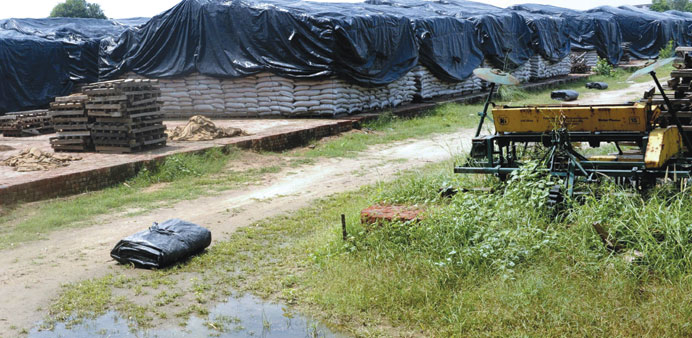
Photographs of rotting food grains left out in the open due to a chronic shortage of storage facilities are an annual feature in newspapers during the current monsoon season.
Reaction among farmers’ groups was mixed, with some saying the government had done too little to support the sector which is the biggest employer nationally.
“If the government can implement it effectively it will benefit the weaker sections of society,” M J Khan, president of International Agriculture Consulting Group, a non-profit organisation from New Delhi, said.
“But the distribution system has to be improved and strengthened for the scheme to be a success.”
Subhash Agrawal, founder of India Focus, a private think-tank based in New Delhi, criticised the use of an ordinance to set up the programme but he said there was a good chance of it being passed into law.
“Politicians don’t want to be seen opposing measures to feed the poor, even if they object to the details of the bill,” he said.
The Congress has a record of passing large welfare programmes such as the 2005 Rural Employment Guarantee Act, which guaranteed a minimum number of days of public employment. But it has suffered a scandal-hit second term undermined by corruption.