


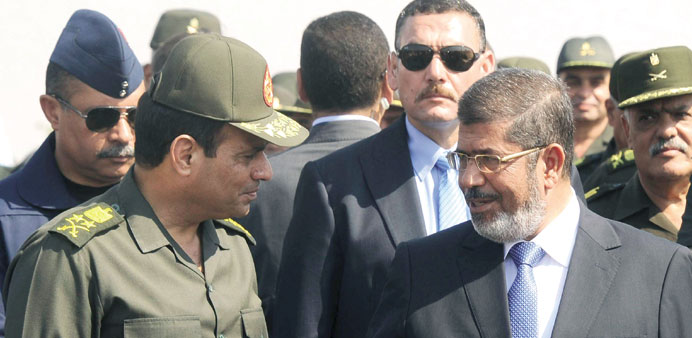
Mursi speaks with Sisi in this October 10, 2012 file photograph.
Reuters/Cairo
When President Mohamed Mursi swept aside the ageing commanders of Egypt’s military a year ago and named a soft-spoken, deeply religious younger general to head the armed forces, it was a demonstration that the military was now subordinate to Egypt’s first freely elected leader.
Fast forward one year, and now it is the general, Abdel Fattah al-Sisi, who has swept aside the president.
At the time of his appointment last August, the choice of Sisi, 58, seemed to suit both Mursi and the younger generation of army commanders seeking promotion after years under older generals, like 78-year-old Field Marshal Hussein Tantawi, Mubarak’s defence minister for two decades.
The army had produced the autocrats that had ruled Egypt for the previous 60 years. It had run the country itself during the tumultuous 16 months after the revolution that toppled the last general to serve as president, Hosni Mubarak.
And it had seemed reluctant to hand power to Mursi until the new president briskly dispatched Tantawi and a host of other commanders into retirement.
Egyptians wanted their soldiers back in barracks, and the charismatic, chisel-jawed Sisi spoke like a man who would keep them there. Over the course of the next year, Sisi warned of unrest and political divisions, but repeatedly held firm in asserting that the army should not return to politics.
“The armed forces’ loyalty is to the people and the nation,” Sisi said in November when Mursi’s supporters and opponents clashed on the streets over plans to introduce a new constitution.
Sisi finally ditched his refusal to pick sides on Monday, announcing a dramatic ultimatum that gave Mursi, the man who had chosen him, just 48 hours to agree on a power-sharing deal with his rivals.
A career military man, Sisi was groomed for a leadership role after serving in top roles in the command, intelligence and diplomatic branches of the armed forces.
Among his previous postings were a stint as defence attache in Riyadh and command positions in the Sinai Peninsula which borders Israel and in the Northern Military Region which includes the second city of Alexandria.
“He had been carefully prepared for a high command position,” said Robert Springborg, an expert on the Egyptian military based at the Naval Postgraduate School in Monterey, California.
Apart from his comparative youth among top ranking commanders, two other attributes made him a good fit for the Islamist Mursi seeking a new generation of military leaders.
In a military known for its secularism, Sisi is a devout Muslim, whose wife is said to wear the niqab full-body covering. And after a year at the US Army War College in Pennsylvania in 2005-2006, he was comfortable with the US, which funds Egypt’s military with $1.3bn a year.
“Insiders in the US government and military were aware of him. He was a name that was mentioned when people talked about next generations,” said Springborg.
He had a favourable reputation among those who worked with him in the American military, although his course work was described as showing Islamist leanings, Springborg said.
“Islamic ideology penetrates Sisi’s thinking about political and security matters,” he said, citing material Sisi produced while at the course.
Steve Gerras, a retired army colonel who was Sisi’s faculty adviser at the college, described him to Reuters as a serious student and pious Muslim, open to the US and passionate about Egypt’s future.
Islamist rule fails in Egypt: Assad
AFP/Damascus
Syrian President Bashar al-Assad said the massive protests against his Islamist Egyptian counterpart brought the fall of “political Islam”, in statements posted yesterday on his official Facebook page.
“What is happening in Egypt is the fall of what is known as political Islam,” Assad said in an interview with Syrian state newspaper Ath-Thawra, excerpts of which were posted on the Internet.
“Anywhere in the world, whoever uses religion for political aims, or to benefit some and not others, will fall,” Assad said.
“You can’t fool all the people all the time, let alone the Egyptian people who have a civilisation that is thousands of years old, and who espouse clear, Arab nationalist thought,” he added.
“After a whole year, reality has become clear to the Egyptian people. The Muslim Brotherhood’s performance has helped them see the lies the (movement) used at the start of the popular revolution in Egypt.”
The full, pre-recorded interview is due to be published today, a day after massive street protests in Egypt ended with the ouster of the Brotherhood’s Mohamed Mursi.
There is long-standing animosity between the Damascus regime and the Muslim Brotherhood, and membership in the group has been punishable by death in Syria since the 1980s.
Kuwait issues travel warning
Kuwait yesterday urged its citizens in Egypt to leave “at the earliest” and warned against travel to the country. “All Kuwaitis present in Egypt must leave at the earliest due to the developments and events in various parts of the country,” the official Kuna news agency cited ambassador Rasheed al-Hamad as saying. He also called on Kuwaitis to delay trips to Egypt due to the “unstable situation”. Kuwait becomes the first Arab country to issue a travel warning to Egypt. Thousands of Kuwaiti students are studying at Egyptian universities while tens of thousands of Kuwaiti tourists normally visit Egypt every year.
Women protesters ‘sexually assaulted’
Close to 100 women have fallen victim to “rampant” sexual attacks in Cairo’s Tahrir Square during four days of protests against Mohamed Mursi, Human Rights Watch said yesterday.
“Mobs sexually assaulted and in some cases raped at least 91 women in Tahrir Square... amid a climate of impunity,” HRW, which is based in New York, said in a statement.
It cited figures from the Egyptian Operation Anti-Sexual Harassment/Assault, which runs a hotline for victims of sexual assault, showing that there were 46 such attacks against women on Sunday, 17 on Monday and 23 on Tuesday.