


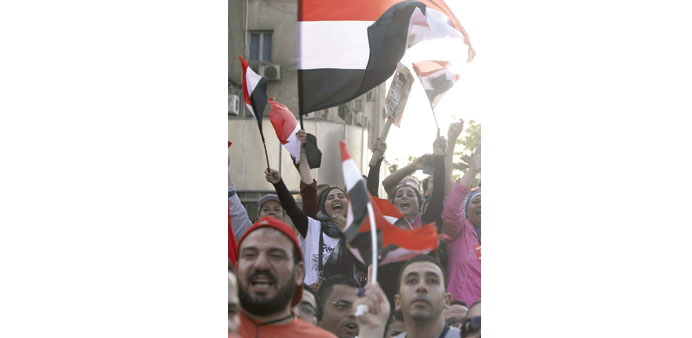
Anti-Mursi protesters wave Egyptian flags as they celebrate in front of the Republican Guard headquarters in Cairo yesterday.
AFP/Cairo
In their tens of thousands, they cheered, ignited firecrackers and honked horns as soon as the army announced President Mohamed Mursi’s rule was over, ending Egypt’s worst crisis since its 2011 revolt.
Camped out in Cairo’s iconic Tahrir Square for a week, the anti-Mursi protesters let loose with an outburst of joy when military chief General Abdel Fattah al-Sisi brought them the news they all were waiting to hear.
As the din rang out for over an hour in Tahrir, epicentre of the Arab Spring uprising that ousted dictator Hosni Mubarak, groups of overjoyed revellers carried members of the security forces on their shoulders as heroes.
Across town near Nasr City, where Mursi’s Islamists had gathered in a counter-demonstration, one celebrator Omar Sherif said: “It’s a new historical moment. We get rid of Mursi and the Muslim Brotherhood”.
The protesters had been forced to wait anxiously until the announcement at around 9pm (1900 GMT), with the crowd building up slowly as day turned to night.
“Egypt, Egypt” and “Leave, Leave,” they chanted outside the defence ministry building, as reports came in that the army was deploying dozens of armoured vehicles near Islamist gatherings elsewhere in the capital.
With broad grins, they sang patriotic songs they have become accustomed to hearing as the same tunes have been pumped out on state television in the weeks leading up to the crisis.
“Mursi deserves his end. He was the president of the Muslim Brotherhood, not of Egypt,” said Cairo resident Amr Mohamed, who carried his 40-day-old daughter in his arms as he marched to the Ittihadiya presidential palace.
A group of housewives put a table in the street and handed out dates and free cups of water, as celebrations erupted when a television station reported that Mursi had been placed under house arrest.
Upon hearing the rumour, one elderly man kneeled down on an Egyptian flag and said “Allahu Akbar.”
That report proved unfounded, but officials did say security forces had imposed a travel ban on Mursi and his top Islamist allies over their alleged involvement in a 2011 prison escape.
Abdel Khalek Abo Risha, 56, who came to the protest from Tanta city in the Nile Delta, said: “I only expect Mursi to be toppled. No other options”.
Nehal Serry, a woman who helped to organise the refreshments, said: “This is for the sake of Egypt. We are celebrating that we are getting rid of Mursi”.
The gathering in Tahrir dwarfed a rally by the embattled president’s supporters in Nasr City.
“Come here O Sisi, Mursi isn’t my president,” the protesters chanted, referring to army chief and defence minister, General Sisi.
The powerful military had issued a 48-hour deadline on Monday for Mursi to meet the “people’s demands”, a day after millions of protesters took to the streets across the troubled country calling for him to resign.
But thousands of people had gathered in Nasr City in a show of support for Mursi, despite an attack by a group of men that killed 16 of them and left 200 injured overnight.
That was before the military moved in to disperse them, however, with AFP correspondents reporting they had seen dozens of armoured personnel carriers ominously heading to Islamist gatherings at Cairo University, Heliopolis, and Nasr City.
A military officer said later that the “Islamists are not allowed to get out of Rabaa Square today, so that they can’t cause any chaos.”
Dozens of military armoured personnel carriers completely surrounded the square, with troops putting up barbed wire and helicopters buzzing overhead.
Those inside could be heard firing birdshot, although they were outgunned and remained stuck behind the barricades.
Army vehicles surrounded the protest outside the Rabaa al-Adawiya mosque in Nasr City, where Mursi supporters have been camping out for days vowing to defend his legitimacy.
“It’s a coup d’etat against an elected president,” said Ahmed Abulmagd in Nasr City. “Mursi was betrayed.”
Other parts of the capital were eerily quiet, as many chose to stay at home in fear of becoming caught up in more bloodshed.
“I’m so worried, the future of my country will be written in the next few minutes,” said one taxi driver as he waited for passengers in a neighbourhood where the shops were all boarded up.
President ‘made many foes, mishandled economy’
Reuters/Cairo
In the end, the army sided with the protesters and the cruel joke was on the president: whether it was tragedy or comedy, placards reading “Egypt and Mursi don’t mix” got the biggest laugh on Tahrir Square.
The armed forces overthrew President Mohamed Mursi yesterday, declaring that he had “failed” the Egyptian people.
A poor farm boy from the Nile Delta, made good through an American education and pious loyalty to the underground Muslim Brotherhood, Mursi was shoved blinking from obscurity a year ago to become Egypt’s first freely elected president.
Taking on a role that the Brotherhood had feared might be a trap sprung by a hostile bureaucracy inherited from the old regime, Mursi’s personal ratings were sapped by an economy in free fall and one clumsy policy move after another.
He was fatally undermined by his failure to shake a conviction among the talkative urban elites that he was the clownish pawn of a secret society of religious zealots.
When, in January, he ventured a few words in English during a visit to Germany, he presented himself as a perfect fall-guy for a new breed of political comic wowing television audiences with the freedoms won in the revolution on Tahrir two years ago.
“Gas and alcohol don’t mix,” Mursi told a bemused Berlin audience, his English stilted and tapping the table for emphasis to make a point about road safety.
The clip, as mocked by a satirist on prime-time TV, went viral on social media among Egypt’s Anglophone liberal elite. When the show’s host Bassem Youssef, who revels in being “Egypt’s Jon Stewart”, was hauled in for questioning for insulting the president, the joke just grew.
When someone first wrote “Egypt and Mursi don’t mix!” on a placard, the slogan took off; soon millions were in the streets and a beleaguered Mursi was left fuming in rambling speeches about the personal iniquities heaped on him by the media.
Samer Shehata, an expert on Islamist Arab politics at Oklahoma University, summed up the dilemma Mursi’s fate has exposed in Egypt, where liberals are celebrating the military toppling a democratically elected leader: “Its politics are dominated by democrats who are not liberals and liberals who are not democrats,” Shehata wrote in the New York Times.
Mursi and his allies in the Brotherhood’s Guidance Council - Egypt’s liberals called them his puppeteers - also made mistakes: “He has been a disastrous leader,” Shehata said. “Divisive, incompetent, heavy-handed and deaf to wide segments of Egyptian society who do not share his Islamist vision.”
Broken promises on the economy in particular, where people have suffered shrinking real incomes and lengthening lines for fuel, widened the appeal of a protest movement rooted in a liberal opposition that repeatedly lost elections to Islamists.
“Mursi has alienated the other forces, he didn’t handle the economy well and he made many enemies - in the courts, in the army, the police, the media,” said Khalil al-Anani, a senior fellow at Washington’s Middle East Institute currently in Cairo.
Highlighting the “media warfare”, he added: “He was fighting on many fronts at the same time and that is always a very bad political tactic. He united the opposition against him.”
As hopes for consensus faded, Mursi ploughed on regardless, casting his opponents as bad losers who spurned his outstretched hand. His allies, meanwhile, were whittled down to Islamists at the extreme religious right.
Mursi defended his legitimacy as an elected leader in a keynote speech last week before an invited audience of cheering supporters, after a first warning from the army to embrace his opponents. Broadcast live on national television for nearly three hours, it was a mark of a stubborn failure to understand how to communicate beyond the Brotherhood’s electoral base.
“He knows his primary audience is not opposition supporters or secular-minded urbanites,” the International Crisis Group’s Yasser El-Shimy said of Mursi’s attempt at a new, folksy style.
Mursi, 61, is a civil engineer and lecturer with a doctorate from the University of Southern California. He was raised in a poor farming village a two-hour drive north of Cairo.
Thrust into the presidential race when the Brotherhood’s first-choice candidate was disqualified, he was dismissed at first as the “spare tyre” but did in time grow in confidence.
The novice president stunned Egyptians in August when he sacked Hosni Mubarak’s defence minister, a move that drew grudging respect from some critics, even in the liberal camp.
Visits to China and Iran set a new tone for Egypt’s foreign policy. Brokering an end to a short war between Israel and Hamas won him kudos from Washington and reassured the West that Islamist rule would not end a regional order underpinned by Egypt’s 1979 peace treaty with Israel.
Yet no sooner had Mursi helped settle that international conflict than he set off another one at home. A decree allowed the Islamists to complete a constitution free of the risk of legal challenges. Mursi then put the controversial text to referendum, ignoring violent protests. He won, but at a high cost.
As his circle of friends tightened to the likes of the former armed jihadists of Gamaa Islamiya, Mursi found it ever harder to convince critics they could trust him.
Mursi “understood democracy as only being about elections”, said Imad El-Anis, at Nottingham Trent University.
He simply ignored tens of millions who did not vote for him.
This week, General Sisi listened to them and agreed with the jokers. Mursi and Egypt simply did not mix, he decreed.