Reuters/Geneva
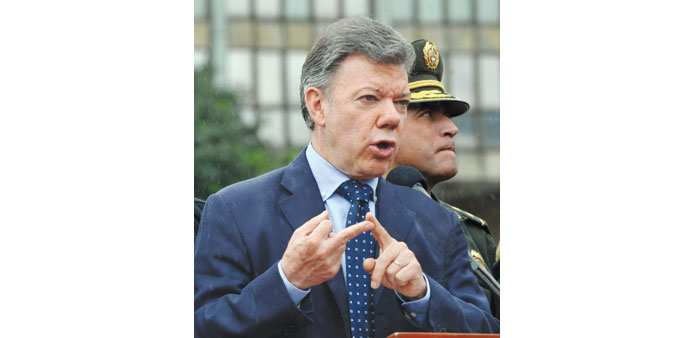
Colombian President Juan Manuel Santos yesterday said an agreement with the Marxist FARC rebels to end their 50-year-old insurgency could be reached by the end of this year if there were “sufficient political will”.
But he insisted that it was out of the question to postpone next year’s presidential election, as demanded by the FARC at peace talks with the government currently under way in Havana.
“If there is sufficient political will, we can achieve an agreement by the end of the year ... as long as there is a wish to advance,” Santos told a news conference at the UN’ European headquarters in Geneva.
The two sides started the talks last November, more than two years after former defence minister Santos - earlier seen as a hardliner on dealing with rebel movements - was elected to the presidency and began putting out peace feelers.
That initially lost him popular support, according to opinion surveys, but he is now advancing in the polls with a 48% popularity rating as public approval of negotiating with the insurgents has grown.
Santos said in Geneva that only a deal to end the fighting between leftist guerrillas and the army, which has bedevilled a dozen successive governments, would keep Colombia on a path of sustainable economic development.
He said postponing the election was “out of the question.”
“I have said from the beginning that I would never make changes to my own benefit. That is a matter of principle for me. It (a postponement) would mean extending my mandate.”
The FARC, and the smaller ELN rebel grouping, want the voting put off to enable the creation of what they call a Constituent National Assembly to usher in radical constitutional and social changes.
At the focus of their long struggle against central governments is what they see as unfair land distribution and policies that excessively benefit the rich as well as foreign, especially US, interests.
But Santos has consistently refused to consider any changes to Colombia’s institutions or its economic model as a condition for the peace talks, and his officials say the FARC appears to be trying to change the terms of the negotiations.
In a joint statement published on Monday, the FARC, estimated to have about 10,000 fighters, and their long-time left-wing rivals the ELN, with about 3,000, said that each wanted the other to be involved in solving the conflict.
The president, in Geneva for a session of the UN’s Economic and Social Council, said he would not agree to include the ELN in the Havana talks or talk with them separately until they released a captured Canadian geologist, Jernoc Wobert.
“I have often said I am in favour of talking with the ELN,” Santos said, “but we will have difficulties if they don’t move in the right direction.”