


By Elena Lalowa & Kathrin Laue
"We’re very happy about it ... but I’m not sure why,” said the man in jogging pants sipping his morning coffee, when asked what he thought of an historic new bridge across one of Europe’s greatest natural barriers, the Danube river.
Throughout history, the Danube, which flows eastward into the Black Sea, has restrained conquering armies. Today, it obstructs free trade. Vehicular ferries cross the river, but for easy transport and spreading trade, bridges are needed.
Sleepy Calafat is the latest place where poverty-stricken Romania has just been connected, road-wise, to the Balkans, further south. But the locals are not sure what to make of the geo-politics of it all, let alone to envisage the ways their lives may change.
The 57-year-old coffee drinker, one of many men whiling away the morning at the pavement tables outside a Calafat cafe, said he is unemployed and does not want his name published. Calafat, population 20,000, has always been a long way off the beaten track.
Mircea Guta, the town mayor, is also wary of predictions. Industrial parks that would make use of cheap labour in Calafat? Not sure.
Paradoxically, Romanian authorities are concerned that their income from road tolls will be reduced. Road users follow the cheapest and most direct route, and Romania was earning very nicely from a more circuitous route used before the bridge opened.
The mayor admits there will be a payback in reduced road maintenance. Fewer trucks mean less work fixing the highways. “There will be both gains and losses,” says Guta carefully. The Danube forms a 500km-long border between Romania and Bulgaria. To date there was just one bridge across it.
Since June 14 there have been two. At Vidin in Bulgaria, on the river’s right bank opposite Calafat, authorities are more upbeat about the smart new bridge. Gergo Gergov, the mayor of Vidin, said: “The bridge will be a motor of development in the tri-border Danube area of Bulgaria, Romania and Serbia.”
Vidin, which was the mighty fortress and military garrison of Bononia under the Roman Empire, could do with a comeback. Bulgaria is the poorest nation in the European Union, and its north-western corner, where Vidin is located, is the country’s poorest region.
Of the region’s working-age population, 14% have no jobs.
Gergov said he expected the bridge to boost tourism and investment there. Strategy papers by the European Union (EU), which picked up a third of the cost of the combined road-rail bridge, paint an optimistic picture.
They say the new crossing is a major development of the Pan-European Transport Corridor IV, which runs from Dresden, Germany, to Prague, Vienna, Bratislava and Budapest, then across the bridge to Sofia and the Greek city of Thessaloniki.
The European Union’s mission is to develop trade and spread prosperity by fixing up roads and punching aside border bureaucracy. But even EU officials do not expect heavy use of the bridge, built by the Spanish engineering firm FCC Construccion, at least initially. They forecast between 1,500 and 2,000 road vehicles a day on the crossing.
That is not much for a highway. By comparison, the freeway circling Vienna, the Austrian capital, is used by 170,000 vehicles daily.
A glance at a roadmap raises the question whether the €270mn ($360mn) bridge was absolutely necessary.
Will the nearly 1.4km-long structure cater to long-distance road traffic between the Balkan region and western Europe?
A nearly uninterrupted stretch of motorways through Macedonia and Serbia already links Istanbul, Turkey with Vienna. Driving directions websites estimate the route can be driven in less than 17 hours.
That route is 200km — and eight hours — shorter than the more eastern one on bumpy roads through Bulgaria, across the new bridge to its northern neighbour Romania and on to Vienna. The route now under development comprises nearly 600km of narrow roads that are in poor repair in places.
According to the German motorists’ association ADAC, which mainly speaks for drivers of cars, not for the haulage industry, the route through Bulgaria and Romania offers “no alternative for long-distance traffic” and the new bridge has regional importance only.
But there are other reasons to favour a route via Bulgaria and Romania.
Since Bulgaria and Romania’s accession to the EU in 2007, the removal of customs barriers for transit traffic through both nations has attracted a growing number of truck drivers. Border delays are the bane of long-distance haulage in Europe.
Truck traffic via non-EU member Serbia has decreased by 35%. Tolls and corrupt police in Serbia, besides the queues for customs checks, have been a disincentive for the trucking companies to choose the Serbian route.
Travelling southward via Romania and Bulgaria is €200 cheaper in fees alone. The disadvantage of a more easterly route until now has been the primitive state of the roads. The usual route passed through the Carpathian mountains via Bucharest.
On a 600km stretch, only 100km exists as a freeway. The rest is slow, snarled, two-lane hardtop. A growth in traffic on the route has increased travel time by a third in the past 10 years.
A key cause of the clogging has been that the old Danube Bridge linking Ruse, Bulgaria, and Giurgiu, Romania — more than 300km downstream from the new bridge — has funnelled all the traffic. Formerly known as the Friendship Bridge and built with aid from the Soviet Union, it opened in 1954.
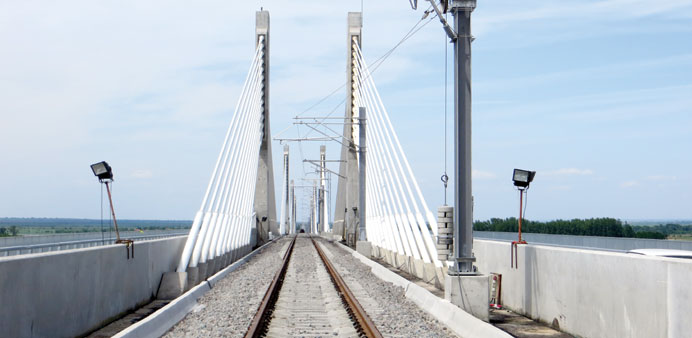
The Vidin-Calafat Bridge, also known as the Danube Bridge 2, will ease transportation that previously relied on a local ferry service. Alla Volkova is one happy Bulgarian. She has been using the ferry for years to travel to Calafat where she runs a market stall selling cucumber seed, plastic sandals, string, detergent and whatever other product she can buy cheap in Romania and vend at a markup in Romania.
Grey-haired Volkova, who declines to disclose her age, says she will now cycle over the bridge. “Got any washing machine decalcifier?” asks a woman customer on the Calafat market. “I sell it for 3 lei ($1) less than in the Romanian stores,” explains Volkova.
“The price saving pays for the bread my family eats in a day,” chimes in the customer after paying. “And riding my bike here every day will keep me fit,” says the vending woman. “The bridge at Calafat-Vidin benefits everyone,” agrees Radu Dinescu, secretary-general of the National Union of Road Hauliers from Romania (UNTRR).
In the view of Johannes Hahn, EU commissioner for regional policy, the bridge will be an “incentive” for further infrastructure development.
Bulgaria was the driving force behind the bridge project.
Romania, on the other hand, dragged its feet, because almost all of its politicians saw the bridge as being too advantageous to Bulgaria, historically regarded as Romania’s competitor. Hahn said he hoped that the new bridge would lead to improved co-operation between the two neighbours. — DPA