


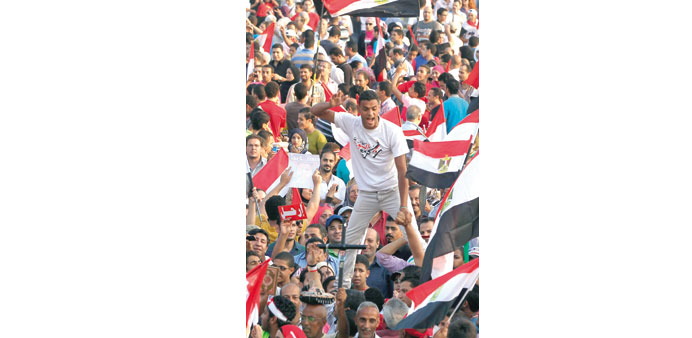
Protesters shout slogans against Mursi in Cairo yesterday.
Reuters/Cairo
Egypt’s army has plans to push Mohamed Mursi aside and suspend the constitution after an all but impossible ultimatum it has given the Islamist president expires in less than 24 hours, military sources told Reuters yesterday.
Mursi defied a demand by the armed forces chief on Monday that he agree to share power with his opponents within 48 hours or have the generals take charge. Calling the army statement misleading and divisive, he said he would stick to his own plan.
But time has all but run out for Mursi, as liberal leaders are refusing to talk to him. Opponents have been dancing in the streets since the intervention by General Abdel Fattah al-Sisi.
Military sources told Reuters that, assuming the politicians failed to end a year of deadlock under Mursi before today’s 5pm (1500 GMT) deadline, the generals had their own draft programme ready to implement - though it could be fine-tuned in consultation with willing political parties.
Under the road map, the military would install an interim council, composed mainly of civilians from different political groups and experienced technocrats, to run the country until an amended constitution was drafted within months.
That would be followed by a new presidential election, but parliamentary polls would be delayed until strict conditions for selecting candidates were in force, the sources said.
They would not say how the military intended to deal with Mursi if he refused to go quietly. One power he might seek to exercise would be to call a referendum on continuing his term.
Some of his Islamist supporters have vowed to defend what they see as the legitimate, democratic order, even if it means dying as martyrs. And some have a history of armed struggle against the state.
The confrontation has pushed the most populous Arab nation closer to the brink of chaos amid a deepening economic crisis two years after the overthrow of Hosni Mubarak, raising concern in Washington, Europe and neighbouring Israel.
Mursi was looking increasingly isolated as ministers and officials who are not members of his Muslim Brotherhood resigned. He also lost a judicial battle when a court evicted his prosecutor-general and reinstated a Mubarak appointee.
Egypt’s Coptic Pope, spiritual leader of the country’s 10% Christian minority, expressed open support for the anti-Mursi Tamarod (rebellion) movement in a tweet, voicing support for the trio of people, army and youth.
The leading Muslim religious authority, Al Azhar, called for the will of the people to prevail peacefully.
Mursi met Sisi for a second day, his office said, along with Prime Minister Hisham Kandil. A presidential aide told the state news agency there had been no “disagreements” but there was no outward sign of a meeting of minds.
Though Mursi has held out repeated offers of dialogue, liberal opponents accuse him and the Brotherhood of bad faith and have ruled out starting talks with him before the deadline.
After that, former UN nuclear agency chief Mohamed ElBaradei will deal directly with the military on behalf of the main coalition of liberal parties. Also planning to take part are leaders of the Tamarod youth movement, which initiated mass rallies on Sunday that the army says prompted it to act.
Military sources said the armed forces would talk with the opposition National Salvation Front and other political, religious and youth organisations after the deadline.
Among figures being considered as an interim head of state was the new president of the constitutional court, Adli Mansour.
The new transition arrangements would be entirely different from the military rule that followed Mubarak’s fall and more politically inclusive, the sources said.
Then, the ruling armed forces’ council was widely criticised by liberal and left-wing politicians for failing to enact vital economic and political reforms - and for siding with the Brotherhood.
Senior Muslim Brotherhood leaders branded the military ultimatum a “coup”.
The US, which has previously defended Mursi’s legitimacy as a democratically elected leader, stepped up pressure on him to heed the mass protests but stopped short of saying he should step down.
President Barack Obama told Mursi in a phone call late on Monday that the political crisis could only be solved by talks with his opponents, the White House said. Secretary of State John Kerry hammered home the message in a call to his outgoing Egyptian colleague yesterday.
The US has long funded the Egyptian army as a key component in the security of Washington’s ally Israel.
General Martin Dempsey, chairman of the US Joint Chiefs of Staff, spoke to his Egyptian counterpart on Monday. It is unclear how far the military has informed, or co-ordinated with, its US sponsors but an Egyptian official said a coup could not succeed without US approval.
The UN Human Rights office called on Mursi to listen to the demands of the people and engage in a “serious national dialogue” but also said: “Nothing should be done that would undermine democratic processes.”
A senior European diplomat said that if the army were to remove the elected president, the international community would have no alternative but to condemn it.
Yasser El-Shimy, Egypt analyst at the International Crisis Group, said the army ultimatum had hardened positions, making it very difficult to find a constitutional way out of the crisis.
“Things could deteriorate very rapidly from there, either through confrontations on the street, or international sanctions,” he said.
“Mursi is calling their bluff, saying to them, ‘if you are going to do this, you will have to do it over my dead body’.”