


AFP/Cairo
Egypt’s armed forces yesterday warned that if Islamist President Mohamed Mursi failed to meet the demands of the people within 48 hours, it would intervene with a roadmap of its own, after millions took to the streets to demand he step down.
The military’s statement, read out on state television, received a rapturous welcome from Mursi’s opponents who have been camped out in Cairo’s Tahrir Square and a muted response from his Islamist supporters.
The army high command renewed its call “that the demands of the people be met and gives (all parties) 48 hours, as a last chance, to take responsibility for the historic circumstances the country is going through”.
“If the demands of the people are not met in this period... (the armed forces) will announce a future roadmap and measures to oversee its implementation,” the statement said.
The Muslim Brotherhood, on whose platform Mursi won Egypt’s first freely contested presidential election in June last year, said it was “studying” the army’s statement.
Senior Brotherhood leader Mahmud Ghozlan told AFP that the group’s political bureau would meet to decide its position.
Tamarod, the grassroots campaign behind Sunday’s massive protests, welcomed the statement by the armed forces which it said had “sided with the people”.
It “will mean early presidential elections”, Tamarod’s spokesman Mahmud Badr told reporters.
Thousands of jubilant protesters poured into the streets of Cairo, Alexandria and other large cities after the statement was broadcast. Raucous cheers rang out across main squares.
In Tahrir, protesters voiced their support for army chief and Defence Minister General Abdel Fattah al-Sisi, chanting: “Come down Sisi, Mursi is not my president.”
Analyst Hassan Nafea, a political science professor at Cairo University, said the ultimatum was a clear demand for the Islamist president to step aside to pave the way for fresh elections.
“He has been given 48 hours to accept what the people want and there is only one demand and that is to hold early presidential elections,” Nafea said.
The army, which led a tumultuous transition after the 2011 revolt that ousted president Hosni Mubarak, had given all parties one week to reconcile their differences.
“This week, there has been no sign of gestures or acts,” the army said.
“Wasting more time will lead only to more division... which we have warned and continue to warn against.”
Egypt has been deeply divided between Mursi’s Islamist supporters and a broad-based opposition.
The huge turnout for Sunday’s protests, which the military put at millions nationwide, handed the initiative to the opposition Tamarod movement, which gave Mursi until 5pm (1500 GMT) today to quit or face an open-ended campaign of civil disobedience.
The health ministry said 16 people died in protests on Sunday, including eight in clashes between supporters and opponents of Mursi outside the Brotherhood’s Cairo headquarters.
Early yesterday, protesters set the Brotherhood’s headquarters ablaze before storming it. Looters walked away with petrol bombs, helmets, flak jackets, furniture and documents, an AFP correspondent reported.
“This is a historic moment. The Brotherhood ruined the country, so stealing from them is justified,” one man said.
A senior government official told AFP that four ministers - tourism, environment, communication and legal affairs - had tendered their resignations to Prime Minister Hisham Qandil.
Tamarod - Arabic for rebellion - is a grassroots campaign which says it has collected more than 22mn signatures to a petition demanding new elections.
Opposition leader Hamdeen Sabbahi urged military intervention if Mursi refused to quit, stressing however that the best outcome would be for him to step down of his own accord.
Mursi’s opponents accuse him of betraying the revolution by concentrating power in Islamist hands and of sending the economy into freefall.
His supporters say he inherited many problems from a corrupt regime, and that he should be allowed to complete his term which ends in 2016.
They organised counter-demonstrations in the run-up to Sunday’s protests but they failed to draw the numbers that the opposition succeeded in bringing out onto the streets.
World leaders voiced alarm at the bloodshed that marred Sunday’s demonstrations.
US President Barack Obama, whose government is a major military aid donor to Egypt, called on all sides to show restraint.
He did not take a position on whether it was time for Mursi to go, but called on his government to reach out to the opposition.
“What is clear right now is that although Mr Mursi was elected democratically, there is more work to be done to create the conditions in which everybody feels their voices are heard,” he said.
The UN warned that the outcome of the turmoil in Egypt would have a major bearing on other countries in the Middle East where authoritarian governments were overthrown after the Arab Spring of 2011.
“What Egypt does with its transition will have a significant impact on other transition countries in the region,” said UN deputy spokesman Eduardo del Buey.
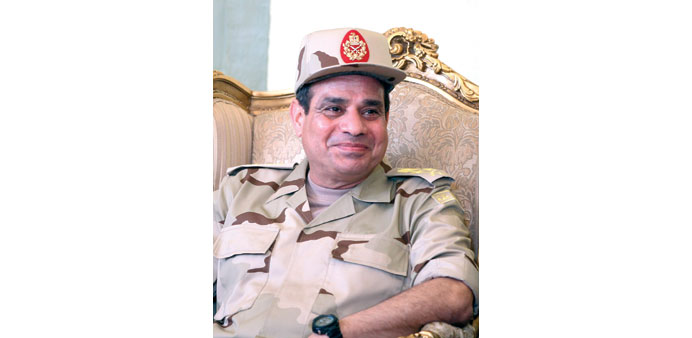
General Abdel Fattah al-Sisi: army chief