


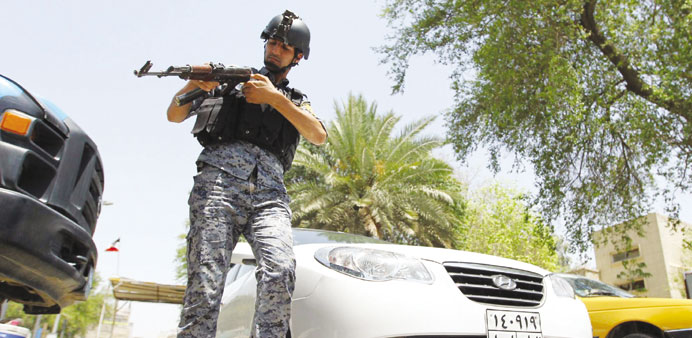
An Iraqi policeman checks his weapon at a checkpoint in Baghdad yesterday.
AFP/Baghdad
More than 2,500 people were killed in Iraq in the past three months, UN figures showed yesterday, a surge of violence that has fanned fears the politically-deadlocked country is slipping back into all-out bloodshed.
The toll comes as the country grapples with months of protests by the Sunni Arab minority, tensions along a swathe of disputed territory in north Iraq and a protracted political standoff that has left key pieces of legislation unresolved.
The violence showed no signs of letting up yesterday as a new attack left eight former anti-Al Qaeda fighters dead.
The UN mission in Iraq said a total of 761 people were killed across the country in June, bringing the overall death toll for the past three months to 2,518.
Most of those killed in June were civilians and a further 1,771 were wounded as a result of violence.
Figures compiled by AFP, meanwhile, showed 452 people were killed by violence in June, bringing the total death toll since April to 1,527 - or twice as many as those killed in the first three months of the year.
Attacks in June targeted a wide cross-section of Iraqi society—government targets and security forces were hit by car bombs, mosques were struck by suicide attackers, anti-Al Qaeda militiamen were shot dead, and Iraqis watching and playing football were killed by blasts.
“They (militants) are intent on causing large number of casualties, to embarrass the government, to raise frustrations and possibly stoke a return to militias again,” said John Drake, a Britain-based analyst for risk consultancy AKE Group.
“There’s something about this period that’s very familiar. It feels like we’ve gone back several years.”
“I remember saying the same things in 2007,” he added, referring to the brutal sectarian war that blighted Iraq in 2006 and 2007, leaving tens of thousands dead.
The UN and AFP figures were markedly higher than those compiled by government ministries, which pegged last month’s toll at 240 dead and 379 wounded.
The surge in violence comes amid a protracted political standoff within Iraq’s national unity government, with little in the way of landmark legislation passed since 2010 parliamentary elections.
And while political leaders have pledged to resolve the dispute, with Prime Minister Nuri al-Maliki meeting his two main rivals last month in a bid to ease tensions, no tangible measures have been agreed.