By Bonnie James
Deputy News Editor
Minus 196C: the temperature inside the liquid nitrogen-filled storage tanks at Virgin Health Bank’s secure laboratory within the Qatar Science & Technology Park is displayed on a monitor.
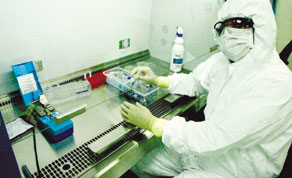
Wearing a chest protection apron, special gloves and a helmet with a full-face visor, processing manager Faizal Patel opens the lid of the main tank.
Lifting up a metal rack with eight compartments, Patel places a rectangular cassette containing the processed stem cells into a vacant slot, notes the rack and slot numbers once again and returns the rack to its position.
Inside the cassette is a 20ml storage bag which contains stem cells harvested from blood drawn from the umbilical cord of a baby born a few hours earlier in a Doha hospital.
The stem cell unit will be stored for 20 years under Virgin Health Bank’s Family Banking service and is for the exclusive use of the family concerned.
Stem cells, which are the master cells of the human body, are already being used in the treatment of over 80 illnesses - mainly from matched donors to treat cancers of the blood such as leukaemias, and blood disorders such as sickle cell anaemia and beta thalassemia.
Virgin Health Bank (VHB), granted by Qatar’s Supreme Council of Health the first and only licence to date for cord blood banking in the country, has stored hundreds of units at its state-of-the-art facility, described as one of the best in the world.
Gulf Times recently witnessed exclusively the processing and storage of a cord blood unit at VHB. While Patel gave a tour of the lab as he waited for the unit to arrive, a caesarean section was happening at a hospital in Doha.
“It takes five to 10 minutes to collect cord blood, but this must be done within five minutes of the placenta being delivered to ensure a good collection,” VHB commercial director Andrew Glen explained.
The collection is undertaken in a separate room, away from the mother and her newborn baby, so as not to distract any of the clinical team responsible for their care.
All of Doha’s maternity hospitals carry a stock of VHB’s collection kits and the cord blood collectors are specially trained to ensure high-quality collections.
The bag containing the cord blood is labelled and transported in an insulated container, specially designed to maintain the temperature between 15C and 30C.
The driver who does the transportation is a specially-trained medical courier. On average the trip from the hospital to QSTP takes around 30 minutes.
The accepted international standard for the maximum permissible delay between collection and processing is 48 hours.
“VHB undertakes to process and store all collections within 24 hours and usually the time between collection and processing is significantly less than that,” Glen observed.
At VHB, the custom-designed, secure and sterile lab area has its own air handling unit, separate from the office wing across the corridor. Only a few individuals authorised have access to the lab.
“The reason for that is to ensure that only specially trained personnel enter the processing laboratories. All of the activities which take place within the laboratories and the consumables used are monitored and recorded ensuring that they can be audited. For example, if a syringe is used for a particular sample, the lot number and the expiry date are noted in the processing record for that particular cord blood unit. VHB is regulated by Qatar’s Supreme Council of Health and the UK’s Human Tissue Authority. We believe that strong regulation is important for this relatively new area of medical science,” Patel said.
The lab area is divided into two sections, with one comprising male and female change rooms, showers, toilets, a “goods in” room where everything that is brought in is booked in, and a waste disposal room.
The other section which features a grade B processing room, validation room, and a cryogenic storage facility has its own air handling unit and the pressure inside is higher than that outside, to ensure that impure air stays out and dust and contaminants are pushed out.
The pressure in each room is monitored continuously and if anything goes out of range Patel will be notified by a “traffic light system” in which green means all fine.
If anything goes out of range but not detrimental, the light goes to orange, and if it is something detrimental, for example the pressure has completely dropped, the red light will come on, indicating that it requires urgent attention.
“If we are offsite and something goes out of range, the system will send an sms and also call us, and through remote access we can identify what the problem is and then resolve it,” Patel said.
The monitoring of factors including temperature and humidity are also done manually with chart recorders, as a backup against any potential failure of the electronic systems.
All the equipment is linked electronically to a sophisticated monitoring system which keeps track of various parameters round-the-clock, including the particle counts, the sterility, and the temperatures of the cryogenic tanks, fridges and freezers.
Safety precautions are extreme as oxygen levels will drop if there is a liquid nitrogen leak. There are alarms and oxygen depletion monitors linked to the facility management system.
“If the alarm goes off while we are working in the lab, we have to leave. The doors will automatically open in such a situation and shut again once all have exited,” Patel said.
The cord blood unit has been delivered into the goods in room. Patel labels it with a unique identification code, so that it could be traced back to the source.
The cord blood pouch and the client file are sprayed with a disinfectant, anti-fungal and anti-bacterial solution containing 70% alcohol before passed into the ‘sterile rooms’ through an airlock system with two hatches – the small one to pass the samples and the bottom large one to extract waste materials.
The cleanest room in the VHB lab is the grade B laboratory, which Patel describes as the “most sterile” facility in the whole of the Middle East and cleaner than an operating theatre.
It is in the grade B lab that stem cells are separated from cord blood and prepared for long term cryopreservation for potential transplantation use in future.
Within the grade B lab are two grade A hoods or biological safety cabinets, the interiors of which are completely sterile.
Under one of the hoods, the outlet of the cord blood pouch is welded to a closed system kit which is subsequently docked to the “Bio-Safe Sepax”, stem cell separation machine.
Those entering the grade B lab and the cryogenic storage area need to wear a disposable head-to-toe bunny suit, gloves, facemask and safety goggles.
There are three doors in the changing area. If one is open the other two will remain closed by way of an automatic magnetic control system. This ensures that impure air cannot enter.
In case of a fire alarm, all the doors will open so that anyone inside can escape, following which the doors to the sterile areas would close immediately. Air handling units will continue to operate.
The grade B laboratory is very highly monitored to maintain the sterility. The laboratory, the validation room, and the cryogenic room are cleaned from floor to ceiling on a daily basis with one biocide, on a weekly basis with another biocide, and on a monthly basis with a third biocide.
The wipes used in the grade B lab are gamma irradiated for absolute sterility. The weighing machine is calibrated daily and the 200gm, 50gm, 5gm, and 0.5gm weights annually to ensure accuracy.
Anything that Patel uses in the grade B lab and under the grade A hoods and his gloved hands are sprayed constantly with the disinfectant.
Tryptic Soy Agar plates, a culture medium for microorganisms are also kept open in the lab, including under the hood, to monitor the air for contaminants. The plates are then analysed, on a daily basis, in Virgin Health Bank’s quality laboratory.
Small samples from cord blood are taken into vials for incubation to establish if they have been contaminated, either by an infection in the mother or from the point of collection.
The sample is confirmed again to make sure it is the correct one. Patel weighs the sample, it is 179.7gms. Minus the weight of the bag, there is almost 115ml of cord blood, considered a good sample. Between 80ml and 100ml is the average sample.
Patel notes down on his worksheet, the lot numbers, the expiry dates of the products he is using and the serial numbers of the equipment. This ensures that each time a cord blood unit is processed, all the activities, equipment and consumables used are recorded and available for subsequent audit.
The kit is docked into the Biosafe Sepax cell separation system and the cord blood begins to flow into the machine’s chamber, which later spins at 1400 rpm, a very high speed to allow good separation of blood components.
The red blood cells are the heaviest, so they will be at the bottom, the middle layer will be the white blood cells, and in the top player will be plasma.
An optical sensor in the machine detects the different elements and distributes them into separate bags. It takes about 30 minutes to separate the cells.
At one end of the kit is the 20ml buffy coat bag to collect the stem cell rich cord blood. Once the process is over, the bag is connected to a “Biosafe Coolmix” which brings the temperature down to 4C while slowly infusing a cryopreservative.
The bag is sealed under the hood and moved to the cryopreservation room through the airlock hatch, following which Patel will clean, disinfect and sterilise the grade B lab.
The cryopreservation process will be completed either by Patel or technician Jennifer Mendoza.
The stem cells cannot be placed directly in the tanks holding liquid nitrogen, as they would not withstand the extreme change in temperature.
The reduction in temperature is done at a very controlled rate, from 4C down to about minus 170C over a period of an hour. At 170C all biochemical processes within the cells stop, and the stem cell bag is transferred to the storage tanks.
Each stem cell unit is placed in a smaller quarantine tank for six months, until all the microbiological tests of maternal samples come back negative and then the sample will be moved into the final storage tank.
The small tank can hold 5,000 samples, and the larger final storage tank 10,000 samples. When they become full, more tanks will be added to increase the storage capacity to 50,000 samples.
“Beyond that point, we can extend the cryopreservation room and store up to 100,000 samples,” Patel said.
The liquid nitrogen in the storage tanks is replenished automatically from a 2,000 litre feeder tank kept securely on ground floor and refilled once or twice a week depending on the usage and outside temperature.
In the very hot summer period, liquid nitrogen will be used up more quickly as the transportation pipelines have to be kept cool.
“Our focus is on providing the highest quality services and creating the very best stem cell units, we’re very proud of the work that we do,” Patel added.