


|
|
The Qatar University Farm has collections of medicinal plants, fruit trees and native Qatari plants in addition to various varieties of date palms.
“Lemon grass, sweet basil, curry leaf, neem and rosemary are some of the medicinal plants grown in the farm,” said Dr Talaat A Ahmed, associate professor of plant molecular biology, Department of Biological and Environmental Sciences.
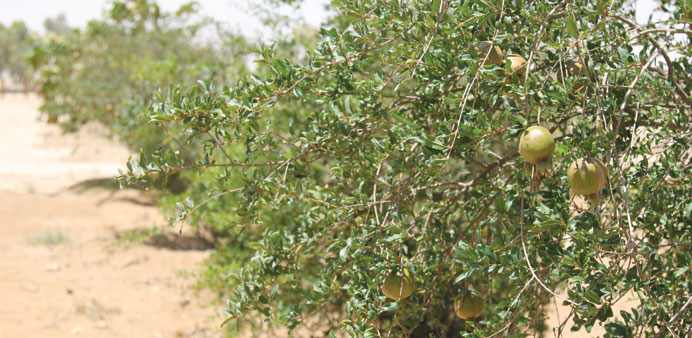
Agriculture engineer and farm manager Abu Baker A al-Taieb explained that sidra, pomegranate, figs, raspberry, olive, and lemon are among the fruit trees.
“We are now collecting Qatari plants and have set apart a big field for the purpose,” Dr Ahmed said. They are being propagated in the nursery before being transferred to the field.
“We are propagating four or five species currently in the nursery and hope to be the main source for Qatari plants in the near future,” he said.
Dr Ahmed had earlier conducted research on using Qatari endemic plants for cosmetic purposes. “Some of my other colleagues in the department are doing research on the medicinal properties of Qatari plants,” he added.
The farm, located in Rawdat Al Faras, about 60km north of Doha, was donated to Qatar University in 1996 by the then Ministry of Municipality Affairs and Agriculture. Both invertebrate and vertebrate fauna are present in the farm, including several varieties of spiders, scorpions, geckos, and the spiny tail lizard, red fox, and the Ethiopian hedgehog.
The birds found in the farm include barbary, palm dove, house sparrow, common mynah, white-cheeked bulbul, red-vented bulbul, European bee-eater, grey francolin and red-backed shrike.