


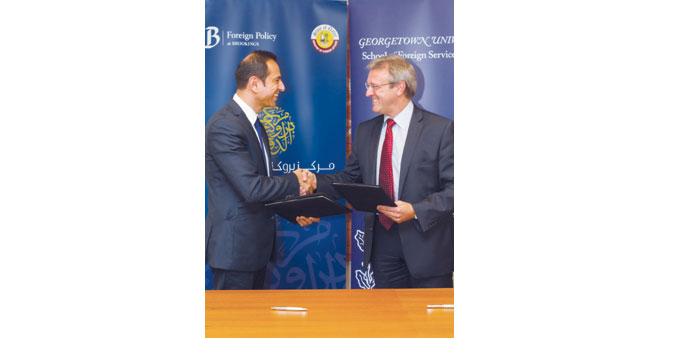
A memorandum of understanding (MoU) signed this month will allow Brookings Doha Centre (BDC) to reserve one or more internships per semester for qualified Georgetown University in Qatar (GU-Q) students.
The MoU will provide a structure for GU-Q students to apply theories and skills learned in the classroom to policy and research work done at BDC. Students who successfully complete their internship will earn one academic credit towards their Georgetown University School of Foreign Service in Qatar degree.
Dr Salman Shaikh, director of BDC, said: “Brookings Doha Centre is always seeking to expand its local capacity and reach. With this in mind, BDC is proud to have formalised its long-standing relationship with Georgetown University’s School of Foreign Service in Qatar. The centre looks forward to providing GU-Q students with first-hand access to BDC’s mission and programming as well as to expanding the students’ research abilities and acquainting them with local business practices. In exchange, BDC looks forward to bolstering its access to and collaboration with the vibrant academic community of GU-Q.”
Dr Gerd Nonneman, dean of GU-Q, described the agreement as an opportunity to engage interns in substantive research in the context of BDC’s policy analysis, in ways that connect naturally to the university’s International Politics curriculum.
“One of the benefits of the Georgetown campus in Doha is opportunities such as this for our students,” Dr Nonneman said. “I know that the high-calibre students Georgetown brings to the arrangement will contribute enthusiastically towards the work of Brookings in Doha. At the same time, our student interns will hone their research capabilities and enhance their professional skills.”
BDC will assign a mentor to each Georgetown intern. The mentor will provide guidance for duties and assignments relevant to independent research, policy analysis and programming on the Middle East.
Successful internship candidates will have a demonstrated interest in Middle East politics or US foreign policy in the region. Along with excellent writing and research skills, a strong academic background will be required. Knowledge of Arabic will be considered a plus.