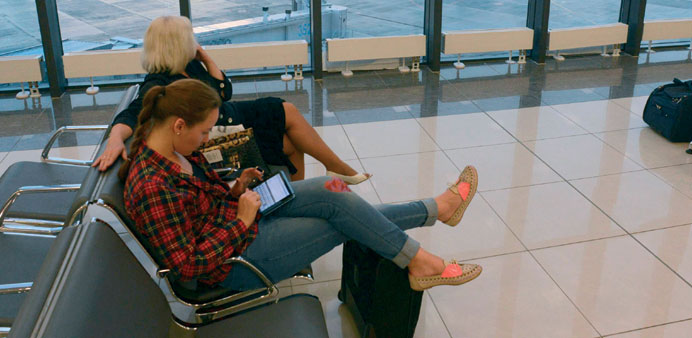
Passengers rest in the transit zone in Sheremetyevo airport terminal F in Moscow yesterday, where US intelligence leaker Edward Snowden reportedly spent the fourth day with his onward travel.
Reuters/Moscow
A former US spy agency contractor facing charges of espionage remained in hiding at a Moscow airport yesterday while the prospect grew of a protracted Russian-US wrangle over his fate.
Ecuador, where Edward Snowden has requested asylum, said a decision could take weeks and asked Washington to argue its case for extradition. Russia said Snowden, whose flight is proving a growing embarrassment for President Barack Obama, was still in the transit area of Sheremetyevo airport.
Meanwhile, Ecuador denied yesterday that it gave a travel document to Snowden that allowed him to travel from Hong Kong to Russia.
“This is not true. There is no passport, no document that was delivered by any Ecuadoran consulate,” senior foreign ministry official Galo Galarza told reporters.
“He doesn’t have a document supplied by Ecuador like a passport or a refugee card as has been mentioned,” Galarza added.
Snowden fled to Hong Kong after leaking details of secret US government surveillance programmes, then flew on to Moscow on Sunday. There was no sign yesterday of him registering for onward flights out of Russia.
“They are not flying today and not over the next three days,” an Aeroflot representative at the transfer desk at Sheremetyevo said when asked whether Snowden and his legal adviser, Sarah Harrison, were due to fly out.
“They are not in the system.”
The logical route for Snowden to take out - and one for which he at one point had a reservation - would be an Aeroflot flight to Havana and a connecting flight to Ecuador.
The choice of alternative flights, while the US presses other countries not to take him in or to arrest him on arrival, would appear to be be limited.
Russian Foreign Minister Sergei Lavrov repeated Putin’s stated opinion that he should choose a destination and fly out as soon as possible, state-run Itar-Tass news agency reported. But Ecuador’s foreign minister indicated a decision on Snowden’s asylum request could take two months.
“It took us two months to make a decision on Assange so do not expect us to make a decision sooner this time,” Foreign Minister Richard Patino said in Kuala Lumpur, referring to the founder of anti-secrecy group Wikileaks, Julian Assange. He added that Ecuador would consider giving Snowden protection before that if he went to Ecuador’s embassy - but Russian officials say Snowden does not have a visa to enter Russia, and the US has revoked his passport.
Snowden, with his surveillance information, remains within the grasp of a Russian state clearly not in a hurry to dispatch him from its territory. Ecuador, which has not in the past flinched from taking on Western powers, is similarly not rushing to banish the uncertainty now plaguing US authorities.
Behind the scenes US officials have been meeting Russian counterparts on a resolution.
Snowden has not been seen in the transit area - the zone between the departure gate and formal entry into the country.
Putin denied he was being interviewed by Russian intelligence and said any US accusations that Moscow was aiding him were “ravings and rubbish”.
That prompted a new extradition demand by Washington, which said there was a clear legal basis to do so.
Putin says he will not extradite Snowden. By declaring that he is in the transit area, albeit unseen, Russian authorities maintain the position that he has not formally entered Russia - a step that would take the dispute to another level.
The row could, however, further fray ties between the US and Russia, which have argued over human rights and Putin’s treatment of opponents in a third term and have squared off over the Syria conflict in the UN Security Council.
Snowden, who worked as a systems administrator at a US National Security Agency facility in Hawaii, has been called a “traitor” in the US for revealing its secrets.
Putin, a former KGB officer, may feel little sympathy for someone who has broken the secrecy code. He has suggested the surveillance methods revealed by Snowden were justified in fighting terror, if carried out lawfully.
But Snowden could be a useful propaganda tool for Moscow, which accuses the US of violating rights and freedoms it vocally urges other countries, including Russia, to protect.