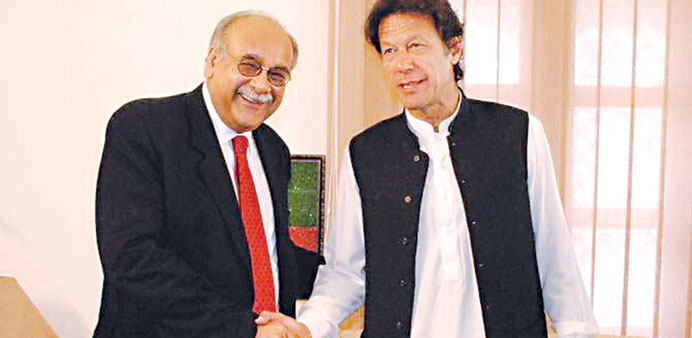
Match of wits: Former interim Punjab chief minister Najam Sethi, left, with PTI chairman Imran Khan, when the two met before the general elections in May.
By Kamran Rehmat /Islamabad
Even though politics and sports mix for negative reasons in some other countries as well, but Pakistan is a standout.
Not only is the Pakistani run of play an unmissable reflection of its polity, the cricket board and the national team boasts characters right out of the parliamentary - or in some cases, unparliamentary - form.
If you ever get confused thanks to the muddle - and the chances are, you often will - know that it is the rule rather than an exception. There is an even chance you will also likely come to appreciate the reason for the cavalier nature of Team Pakistan and why it often flatters to deceive.
In this case, author Grantland Rice’s assertion “it doesn’t matter whether you win or lose, it’s how you play the game” on its head. Powers-that-be in Pakistan love to indulge politics in the only true sport that holds any value for Pakistanis, and is perhaps, the last binding force left in the country.
Over the weekend, Prime Minister Nawaz Sharif - himself an inveterate cricket-lover - provided the latest example of how gatecrashing the party is still the norm. He named Najam Sethi, a 65-year-old veteran journalist, fresh from an interim stint as the chief minister of his home province Punjab as the interim chairman of Pakistan Cricket Board (PCB).
Even though the job is apparently temporary, it is still controversial since Sethi has never been accused of intricate knowledge of the game and neither has he played at the highest level nor is he renowned for any particular brilliance as a cricket administrator.
Cricket, they say, is a funny game - a reference to its unpredictable nature. Funnier still will be Sethi’s call to make his presence felt in an unchartered territory.
As it is, Pakistan cricket lies in a shambles. In more than three decades of following the sport, one has never seen the spirit sag to the extent evident. Yes, there may have been greater turmoil on and off the pitch, but it is difficult to recall another time when the cupboard was so bare.
Pakistan seems to have even run out of talent - at least the kind that has been associated with it ever since the country first burst on the international stage in 1952 as a full Test member - it still remains the only team ever to have beaten England on its maiden tour to the Old Blighty.
How and why has it reached the sorry pass it has? To be sure, the major contributing factor in the slow death has been the militant attack on the visiting Sri Lankan team more than four years ago, which led to the international isolation of Pakistan as a host.
The nature of the beast Pakistan has encountered since signing up for the US-imposed terror war means there is no fool-proof formula to prevent the like of that Lahore episode - Pakistan was extremely fortunate in that not only did the visitors survive to tell the tale, but Colombo only chose to count the blessing while empathising with Islamabad.
But where the country self-destructed is in its subsequent actions even if the criminal negligence shown by the authorities to intelligence reports two months prior to the disastrous incident, which had warned of precisely the kind of attack that eventually took place, were to be set aside.
Ijaz Butt, related to Ahmed Mukhtar, the last ruling party’s defence minister, was made the PCB chairman. If ever there was a walking disaster - a septuagenarian who was hard of hearing, had trouble remembering things, and could barely walk straight - it was him.
When mercifully, his term expired in 2011, President Asif Zardari, the board’s patron-in-chief, appointed another crony, Zaka Ashraf of the Agricultural Development Bank of Pakistan, in his stead!
Ashraf is currently suspended by the Islamabad High Court from office following his “dubious” anointment as the first “elected” chairman of the PCB under the new constitution that finally saw the light of day thanks to the International Cricket Council’s mandatory requirement of democratising cricket boards by June-end 2013.
But that, you can argue with perfect logic, has typically been the story of Pakistan cricket. Where it has taken an unprecedented turn for the worst is in the cast on display. Never has a Pakistani team lacked so much in motivation, heart or form.
In recent times, they have appeared to merely reach the park and go through the motions of being in a contest and, utterly failed.
When a 39-year-old Misbah-ul-Haq Khan Niazi - any resemblance to the last two names with a certain Imran is purely coincidental - assumes the halo of a saviour, it is akin to floating on a rafter in a raging storm.
Considered one of the favourites, Team Pakistan was annihilated in the recent Champions Trophy with key players failing miserably. So short is Pakistan cricket on ideas that the only alternative being bandied about is returning to the mercurial Shahid Afridi, whose temperament has resulted in Pakistan coming to grief more often than one can easily recount.
If that happens - Pakistani fans have deep affliction for nostalgia - there would be a meal ticket, not necessarily a meal.
There is no fly-on-the-wall account yet of the raison d’etre for appointing the unheralded Sethi to one of the top eyeball grabbing positions in Pakistan, but knowing the politics of the species, one cannot rule out a trick or two here.
The highly-informed journalist - arguably, Pakistan’s most celebrated media personality at home and abroad - is left-leaning, and a barely concealed critic of Sharif’s dyed-in-the-wool rightist policies. Winning him over is a decidedly clever bargain.
Two, cricket is in such a bad shape at home that naming anyone from within the ranks would have increased pressure for deliverance — perhaps, a near-impossible task. Throwing Sethi at the deep end would save Sharif from having to take responsibility for its suspected failure.
But there is now a colourful tinge to the national soap opera with rival Imran Khan upping the ante with his own plan to revive lost glory in Khyber-Pakhtunkhwa, where his Pakistan Tehreek-i-Insaf heads the government.
Khan is a cricket legend across the globe and even his worst political detractors eschew the subject for fear of inviting ridicule.
*** The writer may be reached at [email protected]