


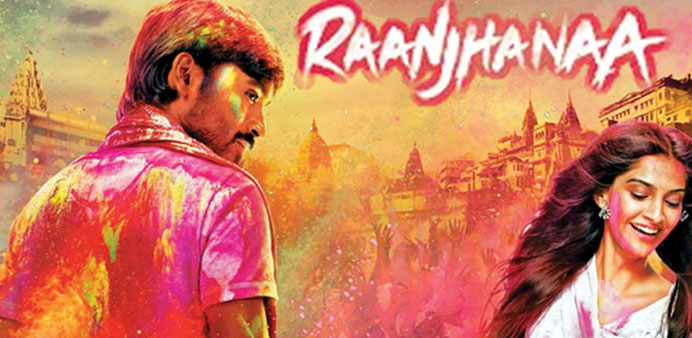
With its outdated script and style, Raanjhanaa is
one film which could have been made 40 years
ago. By Gautaman Bhaskaran
|
|
Long, long ago, I was told that Indians went to cinema for an inexpensive form of entertainment. A film stretched for at least 180 minutes, and was wholesome. It offered romance, tear-jerking lines, emotionally draining situations, comic interludes and finally fights where the hero would vanquish the villain.
The hero would then marry the heroine.
And they (except the baddie and his yes-mouthing cronies) would live happily ever after in what appeared like a mix of the Ramayana and Shakespeare’s All Well That Ends Well. This was what enjoyment was all about.
But I used to wonder whether entertainment could also be something which was not a weepy love story that threatened to end in a tragedy or dialogue which sounded downright stupid or a scene which battered our intelligence. Could not a political debate or a fiery speech or a magic show or even sensibly narrated movie be a source of enjoyment?
Could not a film which provoked a discussion or was written with characters who did not have to sprint across streets, dive into pools, sing songs, destroy marriage alliances and woo lovers standing at the foot balconies on moonlit nights also be recreation? It does not seem so if we look at most of the movies popping out of Indian production houses — now also with foreign collaborators like Fox and Warner Brothers.
Anand L Rai’s second film (after his 2011 Tanu Weds Manu with Madhavan), Raanjhanaa, is one which could have been made 40 years ago. Its script and style are as outdated as a movie made in those times when producers and directors smugly believed that the Indian masses which paid a pittance for a ticket deserved nothing better.
Raanjhanaa begins on the holy lanes and by-lanes of Banaras, before moving into New Delhi — post intermission. Banaras’ love story turns into New Delhi’s political drama, complete with a Chief Minister (who tries hard to mimic the State’s present Chief Minister Sheila Dixit), political thugs, corrupt cops, a rebel youth leader (with his principles still intact), a girlfriend from another religion (with a message that screams), a college-full of doting admirers and a director who grew too ambitious after his simple and sedate girl-and-boy tale called Tanu Weds Manu.
But Dhanush (Tamil superstar Rajnikanth’s son-in-law) is no Madhavan, and cannot be reined in for anything that has got to do with subtlety or sobriety.
Kundan (Dhanush) is a Tamil Brahmin (this is to take care of his Tamilised Hindi, and we have seen that happen even in Kamal Hassan’s case years ago in Ek Duje ke Liye), who lives in Banaras, his father being part of the temple there.
He is smitten by Zoya (Sonam Kapoor), a Muslim whose father is a professor. Kundan’s attraction for her begins when he is a kid, and it continues into his boyhood and later. But as time goes by, Zoya begins to see him as a handyman who helps out in her house, and the eight-year-separation, when she goes to Aligarh and then New Delhi to study in college, drives her even further from him.
Also, she falls in love with a student leader, Akram (Abhay Deol — 37 — and the casting director must have been crazy to get this actor, albeit brilliant, to play a college student), who is not really a Muslim but a Sikh!
Zoya is desperate to get married to “Akram” (I think his real name in the picture is Jasjeet), and forces him to masquerade as a Muslim before introducing him to her staunchly religious father. The marriage is fixed (nobody asks for the boy’s parents), and in a fit of disappointment and rage, Kundan, while helping out with decorations and other odd jobs in Zoya’s house, says yes to a girl (Bindiya, beautifully played by a relative newcomer, Swara Bhaskar), who has been hanging around him, despite his humiliating demands.
Bindiya is once pushed into visiting the doctor about to wed Zoya. At his clinic, Bindiya undresses urging the doctor to examine her, and this is photographed by Kundan, who sends the pictures to Zoya’s father. Out goes the doctor, but Kundan is devastated to learn that Zoya had urged him to do this scandalous thing only to marry Akram.
But Akram is not going to have a cakewalk either, no not with the compulsive lover Kundan around. He chances upon a newspaper picture of Akram with a caption that mentions his real name. The jilted lover storms into the Zoya household and brandishes the newspaper. The cat is out, and Akram not only loses his love but a lot more.
And then Kundan repents, does community service in gurdwaras, while Zoya begins to thirst for revenge against one who destroyed her life. So what if it was all for love.
Does Kundan finally get Zoya? This is unimportant, because writer Himanshu Sharma and Rai mess up the film royally, first by turning a romance into a political sham and later by reducing their lead character (Kundan) into no better than a tea-boy. (Were the duo inspired by foreigners marrying Indian rickshaw-pullers?)
Despite the director’s and writer’s runaway imagination and topsy-turvy sense of logic, some Indian critics have gone ga-ga over Raanjhanaa. My good friend and movie critic, Meena Iyer, writes in The Times of India: “… just sweeps you off your feet with colour and feel.” Another good friend and film critic, Anupama Chopra, pens in Hindustan Times: “This love story is fantastical but these are characters we could know. Their emotions move us — so much so that when Kundan finally breaks down and cries, I wept too.”
This is it. Indian cinema’s greatest weapon is its ability to emotionally blackmail you into flipping for it.
There is more from Chopra: “Until this film, I had only seen the National Award-winning actor (Dhanush) in his blockbuster Kolaveri Di video. But my fears vanished almost as soon as the movie started because in the first few minutes, Dhanush’s character Kundan jokingly acknowledges his lack of good looks.
“And after the first 10 minutes, I was utterly bowled over by Dhanush’s energy and charm. He’s outstanding as the spirited, street-smart son of a pundit in Banaras who is a little boy when he embarks on his epic love story.”
I wish I could share the views of Iyer and Chopra. Raanjhanaa is a love story which I would have seen a million times on the Indian screen. In fact, I have seen much better ones. And as for Dhanush, the poor man has been portraying the underdog for ages. Maybe his plain looks will not permit any other part, and I have not seen any great talent in him either. His range is very limited, and it is possible that if he was not Rajnikanth’s son-in-law, he would not have landed a career in motion pictures.
Kapoor, as Chopra avers, gives her career-best performance as Zoya. In every frame that she is seen with Bhaskar, this bride-in-waiting outshines Kundan’s obsession. Kapoor’s acting is passé, but she is pretty, and Indians (critics as well) adore glam-dolls, not actresses.
Raanjhanaa came us a hard knock on my intelligence, and I am sure it must have at least given a gentle rap on others.
Gautaman Bhaskaran has
been writing on Indian and world cinema for over three decades,
and may be e-mailed at [email protected]