


AFPWaAshington
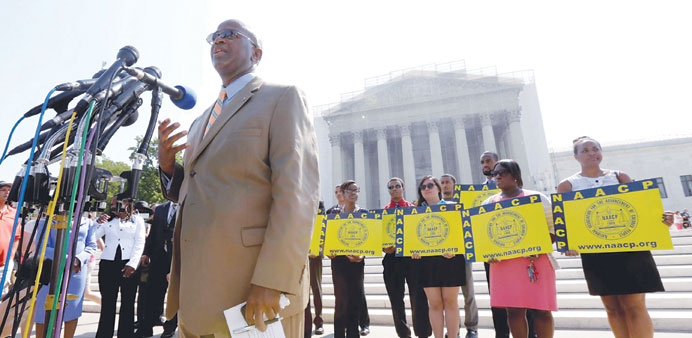
The US Supreme Court yesterday struck down a key part of the Voting Rights Act, which guards against racial discrimination in US states with a segregationist past.
In a hotly anticipated decision, it ruled 5-4 that Section 4 of the 1965 law was unconstitutional, calling on Congress to redefine which states must seek government approval for changes to their electoral codes.
“Our decision in no way affects the permanent, nationwide ban on racial discrimination in voting,” Chief Justice John Roberts said in the majority opinion.
The Voting Rights Act - which was last renewed by Congress in 2006 - is opposed by some states which see it as outmoded, but a number of civil rights organisations argue it is still needed.
Under the act, nine mainly southern states, as well as local governments in seven states, are required to obtain Justice Department approval for any changes to their voting laws.
The case came to the Supreme Court after the re-election of Barack Obama, the first black US president - a landmark that critics pointed to as evidence that the law is unnecessary.
The nine-member court had left the Voting Rights Act alone the last time they reviewed it in 2009, but strongly urged Congress to reform it on the grounds that “things have changed in the South.”
The nine states concerned are Alabama, Alaska, Arizona, Georgia, Louisiana, Mississippi, South Carolina, Texas and Virginia, while the local governments are in states as far-flung as California, Florida, Michigan and New York.
“Section 4 of the Voting Rights Act is unconstitutional. Its formula can no longer be used as a basis for subjecting jurisdictions to preclearance,” Roberts wrote.
“Coverage today is based on decades-old data and eradicated practices,” he said. “Today the nation is no longer divided (as it was in 1965) ... yet the Voting Rights Act continues to treat is as if it were.”
It was up to Congress, Roberts added, to decide whether to draft another formula for pre-clearance “based on current conditions.”
On the core principle that Washington can approve voting-law changes, enshrined in Section 5 of the law, the court said such an “uncommon exercise of congressional power” could be justified by “exceptional conditions.”
The US Senate renewed the Voting Rights Act in July 2006 for 25 years by a vote of 98-0.
But analysts said that without spelling out a formula for determining which states and places are required to ask Washington to approve voting-law changes, Section 5 is as good as void.
“What the Supreme Court did was to put a dagger in the heart of the Voting Rights Act,” Representative John Lewis, a Democrat from Georgia and veteran of the Civil Rights movement, told ABC News.