


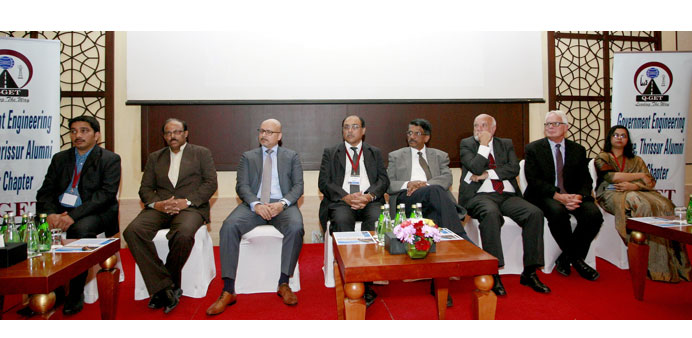
Anthony Holmes, G Vijayaraghavan, Tahir Hanif and IMA-Q president Nizar Kochery at the Qatar Engineers Summit 2013. PICTURE: T K Nassar
Senior Indian technocrat and founder CEO of the South Asian country’s first ‘Technopark’, G Vijayaraghavan, has said India continued to be a favourable destination for foreign investments in spite of the current slowdown, compared to the figures of the first decade of the new millennium.
Vijayaraghavan said this while delivering the keynote address at a seminar on ‘management challenges in the infrastructure development on a global perspective’, organised as part of the Qatar Engineers Summit (QEST 2013), held under the aegis of Qatar alumni of the College of Engineering Thrissur (Q-GET).
While focusing on the challenges in the infrastructure development and the opportunities arising from such initiatives the speaker recalled the numerous mentions made about India in the global competitiveness reports and he also deliberated where India stood in comparison with many other countries.
The speaker explained in detail what prompted many international companies to feel confident about their investments in India. “Along with the growing education, competence and communication abilities of young generations, political conditions and its higher levels of transparency also helped India in no mean way to attract international investments.”
Vijayaraghavan also explained how poor infrastructure could restrict the growth of a country and its people.
Owing to consistent growths in domestic consumption, there has been an increasing energy demand in India, he said while deliberating on how India has emerged as one of the top energy consumers at the international level these days.
Asghal consultant Dr Tahir Hanif said how the profession of a project consultant evolved over the last one century. he insisted that to be successful in project management, one needs ‘people’ who have the right attitude and behaviour. Having the right people working in a project team can mean the difference between success and failure, said Dr Hanif.
Anthony Holmes of Institute for Infrastructure Studies (IIS) said infrastructural development taking place these days would determine the well being of the future generations.
The expert said the demand for infrastructure development to 2030 would be to the tune of $50tn to $70tn, which is equal to annual global GDP.
He insisted in no uncertain terms that the demand for infrastructural development in the next five years should be in excess of the global financial capacity.
While appreciating the services rendered by the engineers from India in different areas of development in Qatar, chief guest and Indian ambassador to Qatar Sanjiv Arora said the trade between Qatar and his country has been growing at a phenomenal rate and a win-win situation is emerging for both countries on account of this.
He singled out for praise the decision of Qatar to invest in the growing telecom markets in India.