


|
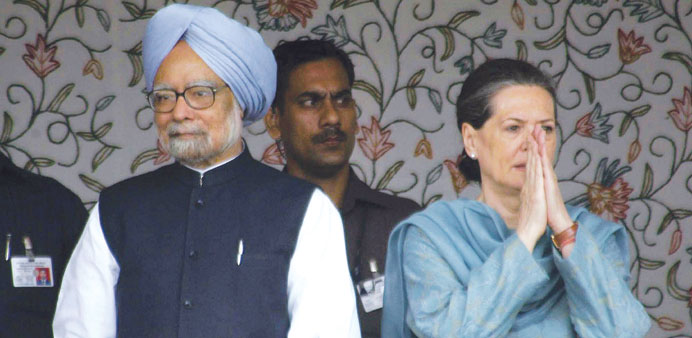
Prime Minister Manmohan Singh faced protests as he made a rare visit to Jammu and Kashmir yesterday, a day after militants killed eight soldiers in the deadliest attack in the state for five years. |
Singh said India was united in the fight against terrorism after landing in the southern town of Kishtwar as part of the two-day trip, his first to the state for three years.
“India is firmly united against terrorism. (We) Won’t let them succeed in their nefarious designs,” Singh said in Kishtwar, where he laid a foundation stone for a hydro-power plant.
Singh stressed in a speech that violence “had shown a sharp decline and was the lowest in last two decades.”
The premier also said more than half of the projects undertaken as part of a $4bn economic reconstruction package for the region have been completed.
It is the first time Singh has visited the state since June 2010 and comes less than a year before India goes to the polls.
Police and paramilitary forces have been deployed in strength across the state for the visit, including in the main city of Srinagar where the prime minister was to give a speech later in the day.
Shops and other businesses, along with schools, banks and offices were closed throughout the city after the three main separatist groups called a strike to protest Singh’s visit.
Government forces were enforcing curfew-like restrictions in the volatile and congested old town in Srinagar.
“We are confined to our homes whenever a politician from Delhi visits our Kashmir,” a resident of the area said by phone, adding that he was not able to leave his neighbourhood for work.
Despite the high security, a group of militants staged an attack on Monday on a troop convoy on the outskirts of Srinagar, killing eight soldiers and wounding 13.
Singh, who is being accompanied by ruling Congress Party chief Sonia Gandhi visited the wounded soldiers at an army base hospital.
Hizbul Mujahideen, a local pro-Pakistan militant, group claimed responsibility for the attack, the deadliest on Indian security forces since July 2008 when a landmine killed nine soldiers on a bus on the outskirts of Srinagar.
More than a dozen armed rebel groups have been fighting Indian forces since 1989 for the region’s independence or its merger with Pakistan and tens of thousands of people, mostly civilians have died in the fighting.
Armed violence had been declining steadily since the early 2000s but the region has been tense following the execution in February of Mohamed Afzal Guru over a deadly 2001 attack on the parliament in New Delhi.
Guru’s execution, carried out in a New Delhi prison without first informing his family, triggered widespread protests in Kashmir where many doubted his guilt.
Chief Minister Omar Abdullah was among those who condemned Monday’s attack, saying it was “aimed at restoring the shattered morale of the militants.”
Abdullah’s National Conference party is an ally of the Congress but has criticised the Delhi government for showing what he regards as a lack of political will to resolve the underlying tensions in what is India’s only Muslim-majority state.
“The Kashmir issue needs to be addressed politically. Economic packages are not a solution to the issue nor can it be found on the point of a gun,” Abdullah said recently.
However yesterday he said the central government was helpful and had it not been for the alliance, the mountain state would face difficulties.