


Reuters/Brasilia/Sao Paulo
Few people in Brazil know what it’s like to be 20-something and angry at the government quite like President Dilma Rousseff.
Rousseff, a Marxist guerrilla during the 1960s who fought against a military dictatorship, now finds herself on the other side of power. She’s struggling to defuse protests by more than 1mn people in the past two weeks that have unsettled markets and could threaten her re-election next year.
The irony has not been lost on protesters, one of whom held up a poster last week with a mug shot from Rousseff’s arrest for subversion at age 22 and the words: “Your ideals were the same as ours! We want that Dilma back!”
Despite her past and her leftist policies now, Rousseff’s aides say that, like other politicians, she has had a tough time understanding what exactly the protesters want and deciding how to react. The hard truth is that she has no easy options.
Protesters’ calls for higher spending on hospitals, schools and public transport could not come at a worse time for the government, which is trying to rebuild its credibility with investors through a renewed focus on fiscal discipline.
The nameless, leaderless protest movement, which blossomed thanks to social media and strong participation of university students, has brought together Brazilians angry about corruption, poor public services and billions of dollars being spent to host soccer’s World Cup next year.
Dozens of people have been injured and two killed, although most of the protests have been peaceful. The demonstrations have subsided in recent days but more are planned for the coming weeks.
While vowing to crack down on a violent minority that have looted stores and vandalised government buildings, Rousseff has praised the democratic spirit of most protesters and vowed during a televised speech on Friday to address their concerns.
Rousseff yesterday met governors and mayors to win backing for plans to build more public hospitals and prioritise a project aimed at improving transportation in Brazil’s cities.
She is also lobbying them to support a congressional bill that would funnel all royalties from new oil fields to public schools and other education projects.
The economy, however, is struggling to gain steam, inflation is eating away at purchasing power, and rising interest rates are making consumer credit more costly. In addition, two straight years of what many economists decry as fiscal slippage under Rousseff make increased spending even harder.
That means Rousseff does not have much room for manouvre and protesters are unlikely to see any concrete improvements to daily life in the near term.
Still, Rousseff’s ability to convince Brazilians that she is at least on their side will be key to preventing the protests from degenerating into even worse violence or becoming so disruptive that they push aside the rest of her agenda at a time when the economy is looking delicate.
“From this point on, she’s going to start making decisions with less certainty” because of the scrutiny stemming from the protests, said Marcio França, a congressman for the PSB Party, part of Rousseff’s ruling coalition.
Rousseff is a widely respected career technocrat but she sometimes comes off as gruff and authoritarian. Her strong approval ratings, however, began to slide before the protests began, a trend that is likely to continue in the near term.
So far, the unrest has been directed at politicians of all stripes, not her in particular. Some aides worried that having Rousseff address the nation could turn her into the primary target of the protesters’ ire.
One thing that Rousseff has not discussed much since the crisis started is her personal past.
Rousseff, the daughter of a Bulgarian aristocrat, was a teenager when she joined one of several small guerrilla groups that proliferated in Brazil in the late 1960s. Her ex-husband Carlos Araujo told Reuters in 2010 that Rousseff helped plan some of the group’s activities but never engaged in violence herself.
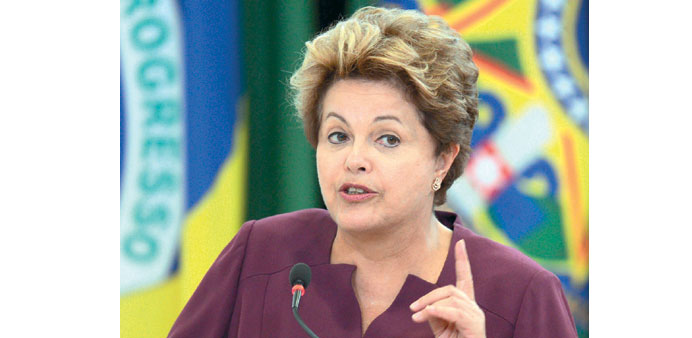
President Dilma Rousseff