


|
|
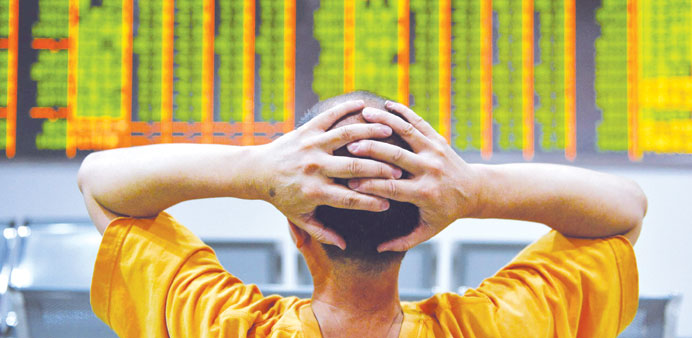
China shares suffered their biggest daily loss since August 2009 yesterday, with financials hammered on worries that the central bank would keep money tight and economic growth could slow sharply.
The CSI300 of the leading Shanghai and Shenzhen A-share listings ended down 6.3% at 2,171.2 points. The Shanghai Composite Index dived 5.3%. This was their respective worst daily losses since August 31, 2009.
The Shanghai financial sub-index plummeted 7.3% in its worst day since November 2008.
Among the biggest losers were smaller banks seen as more reliant on short-term interbank funding, such as China Minsheng Bank, Industrial Bank and Ping An Bank.
The People’s Bank of China commented late yesterday morning that liquidity in the country’s financial system was “reasonable”, repeating a line from a Sunday commentary in the official Xinhua news agency.
The commentary also said the latest spike in money market rates was a result of market distortions caused by widespread speculative trading and shadow financing. The central bank, in its quarterly report on Sunday, pledged to “fine tune” existing “prudent” monetary policy.
Yesterday’s slide came despite the overnight repo rate, a key gauge of liquidity in China’s interbank market, falling by 193 basis points to 7.32% on a weighted-average basis yesterday morning, its lowest since last Tuesday.
Chinese investors have been sent running by a liquidity crisis in the banking system, which has caused lenders to put the brakes on loans.
The rates banks charge to borrow from each other has surged in the past two weeks but the People’s Bank of China has refrained from injecting more cash — owing to fears about a growth of bad debt — which has in turn weighed on the economy.
Hopes that Beijing would step in to provide money were dashed at the weekend when a commentary by the official Xinhua news agency said there was no shortage of funds in the financial system.
It blamed speculation and non-bank forms of lending, often called “shadow finance”, for the problem.
“It’s not that there’s no money, it’s that the money is not in the right places,” the commentary said.
Wu Bangdong, analyst at Changjiang Securities, said: “A lack of policy stance from the central bank during the cash crunch is the main reason that stock markets keep falling, so investors are waiting eagerly for any direction cues.”
Other Asian markets also tumbled yesterday, extending last week’s falls after the US Federal Reserve indicated it could reel in its stimulus later in the year.
However, the Fed’s announcement that it could soon start winding down its bond-buying continued to provide support to the dollar, pushing it back towards ¥100.
Tokyo closed down 1.26%, or 167.35 points at 13,062.78. The losses reversed a 1.42% gain at the start of yesterday’s session that had been stoked by a solid victory for Prime Minister Shinzo Abe’s ruling coalition in elections ahead of national upper house polls next month.
In Sydney, where a number of listed firms rely heavily on trade with China, the market closed down 1.47%, or 69.7 points, at 4,669.1, while Seoul skidded 1.31%, or 23.82 points, to 1,799.01.
Global markets have been sent into a downward spiral since the Fed announcement last week that the economy looked in good enough shape for it to start rowing back on its $85bn-a-month bond-buying scheme.
While the move shows the US economy is gaining strength, dealers fear it will mean there is less cash in the financial system to invest. Tokyo’s Nikkei has been supported however by a strengthening of the dollar against the yen. But the index was negative yesterday despite the dollar edging higher and Sunday’s poll victory for the government.
The ruling Liberal Democratic Party (LDP) and New Komeito secured solid victories in the Tokyo metropolitan assembly election.
“Voters reaffirmed confidence in ‘Abenomics’ and the ruling coalition government, which was symbolically important given the recent volatility seen in equities prices,” Hirochi Nishi, general manager of equities at SMBC Nikko Securities, told Dow Jones Newswires.
Abenomics refers to the big-spending policy put in place by Premier Abe that has been credited with a rallying stock market, weaker yen and a pick-up in economic growth.
“Leading up to the upper house elections in parliament in July, this should reassure investors that the course of present government economic policy will be maintained.”
The dollar bought ¥98.36 on Monday in Tokyo, compared with ¥97.87 in New York late Friday. The euro sat at ¥128.85 and $1.3099, against ¥128.45 and $1.3122.
Oil prices slipped. New York’s main contract, West Texas Intermediate light sweet crude for delivery in August, was down 52 cents at $93.17 a barrel and Brent North Sea crude for August delivery shed 71 cents to $100.20.
Gold fetched $1,283.99 per ounce by 1030 GMT, from $1,293.33 late Friday.
In other markets, Singapore was down 1.6%, or 50.14 points, to 3,074.31; Bangkok fell 2.6%, or 36.41 points, to 1,364.09; Jakarta ended down 1.9%, or 85.91 points, at 4,429.46; Kuala Lumpur ended down 1.01%, or 17.66 points, to 1,738.19; Taipei ended down 0.45%, or 35.28 points, at 7758.03; Manila dived 3.42%, or 211.12 points, to 5,971.05; and Wellington ended flat, edging up 0.98 points to 4,364.05.