


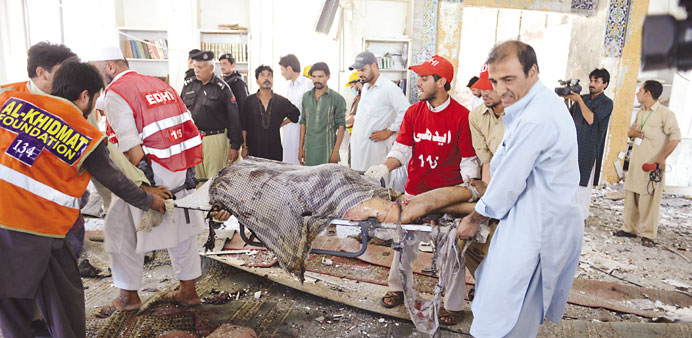
Rescue personnel shift a body after a suicide attack on a Shia Muslim mosque in Peshawar yesterday.
AFP/Peshawar
A suicide attack yesterday killed 15 people and wounded more than 25 others at a Shia Muslim mosque and religious seminary on the edge of Pakistan’s northwestern city of Peshawar, officials said.
The bomber struck in the largely Shia area of Gulshan Colony on the outskirts of the city, which abuts Taliban and Al Qaeda-linked strongholds in the northwestern tribal belt on the Afghan border.
The attack came just days after US officials said they hoped to open peace talks with Afghan Taliban in Doha, capital of the Gulf state of Qatar.
“It was a suicide attack in which 15 people were killed and more than 25 others were wounded,” senior police official Shafi Ullah said at the scene.
“The suicide bomber, who was on foot, first opened fire at police guards who were deployed outside the mosque, then entered the prayer hall where he blew himself up amid worshippers just before the start of prayers,” he added.
The force of the blast punched holes in the walls and roof of the prayer hall, the floor of which was littered with bloodied pieces of human flesh, dead bodies, Islamic books and prayer caps.
Prayer leader Aamir Shakiri said he was just about to join the worshippers when he heard gun shots, followed by a “deafening blast”.
“Thick smoke engulfed the entire mosque and it was difficult to see anything but I was able to see dead bodies and injured people shouting for help,” he said.
Police official Imran Shahid said that at least three suicide bombers had originally intended to carry out the attack.
“Two of them fled while one of their accomplices managed to enter the prayer hall and blow himself up,” he said.
There was no immediate claim of responsibility, but attacks waged by Sunni Muslim extremists against Pakistan’s minority Shia community are on the rise.
Ali Iqbal Qazilbash, a 24-year-old Peshawar University student, said he rushed out of his uncle’s home when he heard the explosion.
“It was really horrifying to see blood soaked and mutilated bodies lying on the floor of the hall,” Qazilbash said.
“I immediately started knocking on doors in the neighbourhood and calling people for help.”
Shias account for 20% of the 180mn population in the nuclear-armed state.
Extremist Sunni militant faction Lashkar-e-Jhangvi claimed responsibility for a series of attacks on Shias in the southwestern city of Quetta that killed at least 25 people on June 15.
Officials also said two members of a pro-government militia were killed when militants armed with guns and rockets attacked their homes in the northwestern tribal district of Bajaur on the Afghan border.
Two tribal policemen were also injured, administration official Abdul Haseeb said.
Writing in English language newspaper The News yesterday, analyst Ayaz Amir reflected on the repercussions for Pakistan of prospective peace talks between the Afghan Taliban and the US.
He said talks would make it almost impossible for Pakistan to open a new military front against domestic insurgents in the northwest.
MQM lawmaker dead in drive-by shooting
Gunmen yesterday shot dead a Pakistani lawmaker, his son and a passer-by outside a mosque in the country’s business capital of Karachi, officials said.
Sajid Qureshi, in his early 50s, and his 25-year-old son were targeted in a drive-by shooting as they left a mosque after attending Friday prayers in congested Nazim Abad neighbourhood.
“Gunmen on a motorcycle fired at (Sindh) provincial assembly member Sajid Qureshi, his son and a pedestrian when they were coming out of mosque,” senior police official Amir Farooqi said.
Qureshi was a member of the secular Muttahida Qaumi Movement (MQM), the most powerful political party in Karachi now considering whether to join the government in southern Sindh province.
“He died on the spot, while his son and the third victim died at hospital,” Farooqi said.
Nasir Jamal, a senior member of MQM, confirmed the death of Qureshi and his son.
MQM has long held sway in Karachi, a port city on the Arabian Sea, and its leader-in-exile Altaf Hussain lives in London.
Karachi, a city of 18mn people, contributes 42% of Pakistan’s GDP but is rife with murder and kidnappings and has been plagued for years by ethnic, sectarian and political violence.