


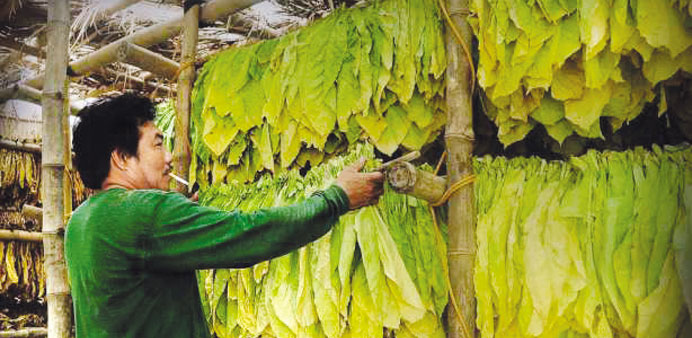
AFP/Manila
Tobacco enriches and corrupts in the dry, sun-drenched northern Philippines, where family fortunes as well as political empires are built on the golden leaf.
For Eddie Habab and the country’s 65,000 other tobacco farmers based in the north of the country, the nicotine-rich plant is like an addictive drug that is difficult to kick.
“It takes months of back-breaking manual labour, but nothing comes close to tobacco in terms of returns,” said the 43-year-old farmer who has put two children through college with the earnings from his crops.
Habab sows the tobacco around November after the rice paddies dry up and harvests the leaves between February to May amid the region’s long dry season.
They are cured in wood-fired barns that produce their golden-yellow tinge and, when he sells them to middle-men, he earns at least three times more than he would than if he had grown corn, peanuts or other alternatives.
Despite higher government taxes on cigarettes imposed by the national government this year, the industry is expanding with 84,000 tonnes of tobacco expected to be grown across the country’s north this year.
This is about 13% higher than last year, according to National Tobacco Administration, the chief industry regulator.
The tobacco feeds the habit of more than 17mn Filipino smokers, or roughly 20% of the population, yielding nearly $700mn in annual tax revenues.
Fifteen percent of the taxes on tobacco sales are by law returned to the areas that plant them, a bonanza worth $140mn each year, the regulatory agency said.
About 70% of that now goes to Ilocos Sur province, the country’s top tobacco-growing area, according to provincial governor Luis Singson.
The two-decade-old law states the money must be spent on improving the lives of the farmers, and Singson said the tobacco funds had proved a lifeline for the formerly cash-strapped province.
“It’s stirred our economy,” he said.
However, the tax funds are regarded by some critics as slush funds for the politicians who rule those areas, one element of entrenched corruption that has for decades been a trademark of Philippine politics.
Father Sammy Rosimo, a Catholic parish priest in Ilocos Sur, said the disposition of the levy funds was poorly regulated and thus a magnet for financial skullduggery. “There are no checks and balances, so the officials entrusted with the money can spend them on pretty much anything,” Rosimo said.
In the most infamous case, Singson admitted he gave P130mn in embezzled tobacco levy funds to then-president Joseph Estrada in 2000. The admission, along with explosive evidence of other corrupt deals, led to Estrada’s impeachment in 2001 and subsequent conviction in 2007 of plunder, or illegally enriching himself.
Singson won immunity by testifying at Estrada’s trial. Singson said the embezzlement was a one-off misuse of the tobacco revenues, done as a misguided favour for his then-friend. “I agreed to be used by a corrupt president,” he said, while insisting he was not corrupt himself and that the tobacco levy funds had otherwise always been properly spent in his province.