


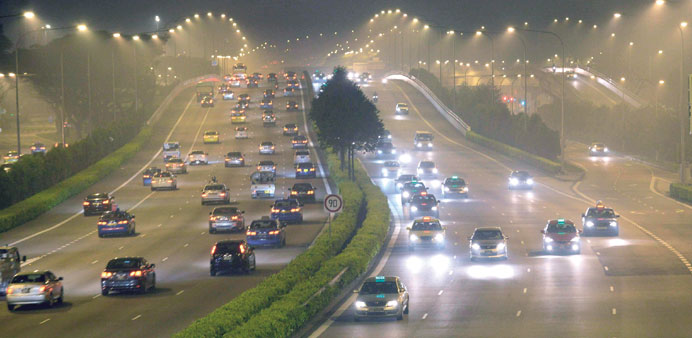
Motorists travel along the hazy Central Expressway in Singapore yesterday.
AFP/Singapore
Smog levels in Singapore hit a record high yesterday as raging forest fires from neighbouring Indonesia triggered a major health alarm and sent residents of the densely populated city-state scrambling for face masks.
Singapore’s air pollutant index soared past the government-designated “hazardous” level of 300 before midnight as officials in both countries desperately sought a solution to the environmental crisis.
The previous high of 226 was recorded in September 1997 at the height of a Southeast Asian calamity resulting from vast amounts of haze from Indonesia, where slash-and-burn farming generates vast amounts of smoke during the dry season that begins in June.
Foreign tourists joined Singaporeans in expressing dismay at the situation.
“We are going to leave Singapore two days early because we are having trouble breathing,” said Zac Kot, 40, a business owner from the US who was on holiday with his wife and two young girls.
Indignant Singaporeans attacked their government on the web for its handling of the problem. Disposable medical masks flew off drugstores’ shelves as consumers and companies bought them in bulk and placed orders for more.
Singapore Foreign Minister K Shanmugam said as the pollution index escalated that Indonesia “has agreed to a meeting between our environment officials” today.
“During the meeting, our officials will put forward our suggestions on what actions we want to see taken,” he said in a Facebook post.
Even tourists from Indonesia - traditionally the largest source of visitors to Singapore - protested about the smoky haze from Sumatra island, where some farmers and plantations deliberately set off fires to clear land for cultivation.
“It’s not very good, and it’s getting harder to breathe. I just don’t know where to go,” said Rangga Adisapoetra, 30, a risk management executive from Indonesia’s main island Java attending a mobile communications and broadcasting expo.
Despite the health alert, life looked normal in some parts of Singapore. Popular bars and restaurants were packed with their usual midweek crowd who appeared oblivious to the problem. The last major haze outbreak in Southeast Asia was in 2006.
Indonesian Foreign Minister Marty Natalegawa said in Jakarta that his country had taken measures against the haze problem and “we have not had for some time now a recurrence of this type of situation.”
“If there are any companies, national or foreign, who have been involved in any slash-and-burning activities then they must be held to account. Such a wish is not only the wish of our neighbours, but is above all our wish.”
When the hazardous air pollution level is reached in Singapore, the government advises elderly persons with heart or lung disease to stay indoors and the general population to “avoid vigorous outdoor activity”.
Singapore is a compact city-state of 5.3mn inhabitants which welcomed 14.4mn visitors in 2012 - 14.5% of them from Indonesia.
The Indonesian forestry ministry said yesterday that it plans to use cloud seeding to try and unleash rain on Sumatra.
Air quality also worsened yesterday in Malaysia, particularly in the country’s south near Singapore.
Southeast Asia’s worst haze crisis took place in 1997-1998, causing widespread health problems and costing the regional economy billions of dollars as a result of business and air transport disruptions.
Shanmugam, the foreign minister, strongly rebutted charges in Singapore’s robust online forums that it was being soft on Indonesia - a sprawling archipelago of more than 240mn people.
While Singapore has demanded urgent action by Jakarta, Indonesian officials have shifted some of the blame to Singaporean and Malaysian investors with stakes in palm oil companies operating in Sumatra.
Golden Agri-Resources (GAR), a palm oil company listed on the Singapore Exchange with operations in Sumatra, said yesterday that it has had a “zero burning policy” since 1997.
GAR’s website says it is the world’s second largest palm oil plantation company with a total planted area of 464,300 hectares and a market capitalisation of $6.0bn as of March.
“Only mechanical means such as excavators and bulldozers are used in our land preparation,” a spokesman said.
“If illegal fires are started near our estates we take prompt action to put them out and report to the local authorities.”
BELOW: A firefighter tries to put out a fire, which burned a plantation, in Rokan Hilir district in Riau
province, Indonesia.