


|
Brazilian President Dilma Rousseff yesterday sought to defuse a massive protest movement sweeping the country, acknowledging the need for better public services and more responsive governance at all levels. |
Speaking the morning after an estimated 200,000 Brazilians marched in more than a half-dozen cities nationwide, Rousseff said her government remains committed to social change and is listening attentively to the many grievances expressed at the demonstrations.
“Brazil woke up stronger today,” Rousseff said in a televised speech in Brasilia.
“The size of Monday’s demonstrations shows the energy of our democracy, the strength of the voice of the streets and the civility of our population.”
President Dilma Rousseff said that the voices of the hundreds of thousands of youths protesting across Brazil over the huge cost of hosting sporting events like the World Cup must be heard. “These voices need to be heard,” she said in an address at the presidential palace. “My government is listening to these voices for change.”
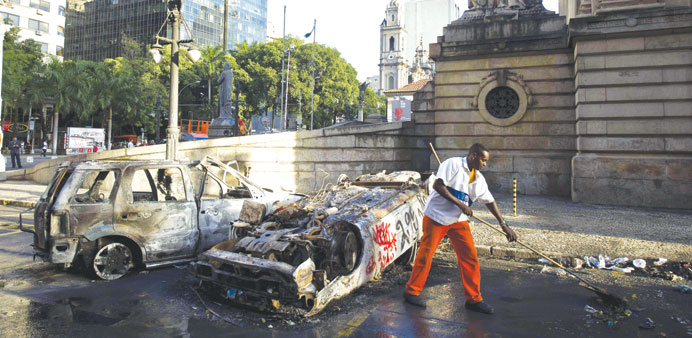
Monday’s demonstrations were the latest in a flurry of protests over the past two weeks that have tapped into widespread frustration with poor public services, police violence and government corruption.
The protests, organised mostly by snowballing social media campaigns, marked the first time that Brazilians have taken to the streets on such a large scale since economic volatility and a corruption scandal led to the toppling of a president in the early 1990s.
The unrest comes at a delicate time for Rousseff, whose administration is struggling to rein in high inflation and get the economy back on track after two years of sluggish growth.
Polls show Rousseff remains widely popular, but her approval ratings began to slip in recent weeks for the first time since taking office in early 2011.
A leftist guerrilla in her youth who was jailed for conspiring against Brazil’s military dictatorship, Rousseff said the sight of so many young Brazilians marching for their rights moved her.
She also said her government sympathises with the many grievances expressed at the demonstrations, from calls for more spending on education and healthcare to better and more affordable public transportation.
“My government hears the voices clamoring for change, my government is committed to social transformation,” Rousseff said. “Those who took to the streets on Monday sent a clear message to all of society, above all to political leaders at all levels of government.”
Some politicians appeared to heed those calls yesterday, giving in to a key demand of the protest movement. Officials in the southern city of Porto Alegre and Recife in the northeast announced plans to lower bus fares.
Anger at an increase in public transport fares in Porto Alegre and other cities helped sparked the protest movement, which grew rapidly after police violently clashed with demonstrators in Sao Paulo last week.
Sao Paulo mayor Fernando Haddad met with leaders of the protest movement yesterday in an attempt to ease tensions, but so far has balked at lowering bus fares. Another march was planned to take place in downtown Sao Paulo later yesterday.