


By Lin Yang
Matsu used to be the most dangerous assignment there was for draftees into Taiwan’s military. Located only 9km from the coast of mainland China, commanders in the island group told of a time decades ago when Chinese special forces frogmen would land under the cover of darkness and kill unsuspecting young soldiers on guard duty.
Nowadays, the islands and their residents are looking to the former enemies for an economic lifeline.
They are planning to open a major casino and resort to target mainland Chinese tourists who have already made the regional gambling hub Macau into the most profitable gaming destination in the world. “The (casino) developer, based on their Macau experience, estimates 3 to 5mn tourists a year would come to such a casino,” said Liu Te-chuan, the director of Matsu’s tourism department. “This is based on our close proximity to China, and most of these visitors will be Chinese.”
In 2012, Matsu became the first Taiwanese island community to pass a referendum to allow casinos to be built. Weidner Resorts, a US-based gaming developer, has offered to spend 50bn Taiwan dollars ($1.67bn) to build a resort with a casino, conference centre, shopping mall and five-star hotel.
The shift in Matsu’s attitude comes at a time when China-Taiwan relations have been at their best since the two sides split after a civil war in 1949. Taiwan President Ma Ying-jeou implemented a policy of detente with China, and opened Taiwan’s borders to mainland tourists in 2008.
That opening has benefited Kinmen, a Taiwan-controlled island to the south of Matsu that is located a mere 4km from China’s coastal city of Xiamen. Old military sites, duty-free shops and a local sorghum factory attracted 408,000 Chinese tourists in 2012, according to the Kinmen county administration.
But so far, the Matsu group has failed to yield the same amount of attention, with only 7,202 travellers coming from mainland China in 2012.
The difference is, Matsu is located further away from a major Chinese city than Kinmen, and does not have anything close to the amount of tourism infrastructure that Kinmen has, although some of its sights would fascinate western visitors.
It has an extensive set of underground docks, now open to the public, that look like something out of an old secret-agent movie. They were carved out of the rock by Taiwan’s military as a refuge to remain operable if China bombarded the islands.
“If we built a casino, then we would have an attraction,” said Yu Cheng-che, an official in Matsu’s tourism department. “There’s a province of 36mn people right across from us, and we’re close to Hangzhou and Shanghai. A casino is something that Kinmen does not have.”
The five main islands of the Matsu archipelago are mountainous, and covered with military bases, artillery foxholes, and underground bunkers. Any resort development would need extensive landfill into the sea in order to create enough flat land to build hotels on.
The islands are served by two airports, but their 1,580m and 1,150m runways are so short that planes need to start their propellers with the brakes on to get a running start in order to make it into the air.
On days of inclement weather, including a characteristic fog that covers the islands, flights and boat services are cancelled. The poor transport infrastructure remains the biggest bottleneck for tourism development in Matsu, according to local officials.
For decades, Matsu’s tiny local population of fewer than 10,000 people took these conditions in their stride because they were financially supported by a heavy military presence that dwarfed the number of locals on the island.
But with tensions between Taiwan and China easing, that presence is no longer needed. Troop numbers have declined from 50,000 in the 1980s to about 5,000 today, according to Matsu’s county. That drawdown has affected people like Wang Hao-lan, a 60-year-old resident who owns a bed and breakfast inside a village of classic Chinese stone houses with clay roof tiles on Beigan, the second largest island in the island group.
Wang used to cook at a local restaurant that primarily fed soldiers. Her sister ran a bathhouse and laundromat that soldiers frequently used. Now, all of her four children have left Matsu because there are no job opportunities left on the islands. They have either gone to Taiwan proper, or moved abroad.
She is trying to make a living renting out her family’s empty village houses to tourists, but when the airports and harbours shut down, her business is forced to take a “vacation”. “Those in Matsu who supported the referendum want to use gambling to help develop the island,” Wang said. “We hope the casino development can also improve the transport infrastructure so that more tourists can come here. That’s why I supported it.”
During last year’s referendum campaign, Weidner Resorts also promised infrastructure improvements totaling 25bn Taiwan dollars. This money, the company says, will be deployed to extend the runway of one airport and upgrade its terminal.
They also plan to upgrade the harbours on the two largest Matsu islands, Beigan and Nangan, as well as the harbour in the city of Fuzhou, China, so that larger ships can dock. A bridge will be built to cross the 3km of sea between the two islands.
“If we don’t make these improvements, we have no way of getting any customers to the islands,” said Julia Lee, the vice president of Taiwan development at Weidner Resorts. “If we don’t provide these improvements, we can’t even start construction.”
So far, all plans have been put on hold, as Weidner Resorts and Matsu residents eagerly wait for Taiwan’s central government to pass a gambling law and set up a regulatory agency.
President Ma Ying-jeou’s cabinet approved a draft of the law in early May, and it has now moved to the Taiwan legislature for passage. Many industry watchers believe the legislature will clear it by year’s end.
During a press conference in early May, Taiwan’s Transportation Minister Yeh Kuan-shih estimated the casino would open its doors in 2019, after a lengthy government approval and construction process.
Matsu’s traditional master, the Taiwanese military, is also supporting the casino project, believing that tourism development will lessen its burden as military spending on the islands wanes.
“It’s a really a win-win for the military and the local residents,” said Brigadier General Chang Yuan-Shiun, the commander of the army on Beigan. “For us, getting private sector help for economic development means we can now focus on our primary mission - defence.”
Besides, Chang’s soldiers are bored on the island when they are off-duty. If he is still here by the time the casino opens, he said he would consider allowing them to gamble and get some rest and recreation. — DPA
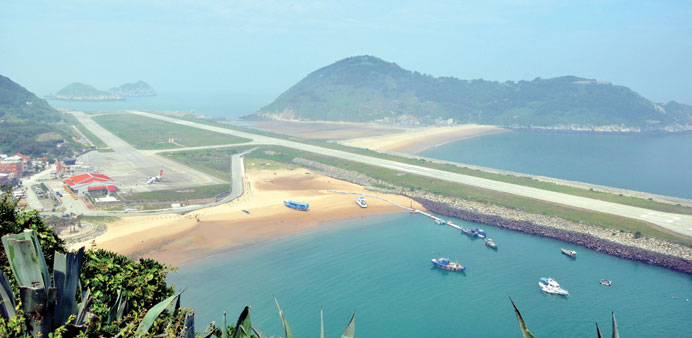
* The runway of the airport on Beigan Island in the Matsu group is only 1,150m long, forcing planes to make a high acceleration start in order to mak