


Reuters/Harare
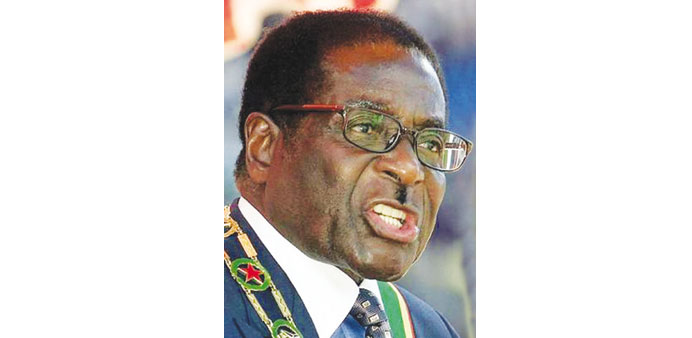
President Robert Mugabe accused political rivals of seeking to delay elections in Zimbabwe because they fear defeat, after regional leaders urged his ruling coalition to ask the courts to extend a July 31 deadline for holding the vote.
His rivals said reforms to restrictive media and security laws were essential for any fair election to be held and that it was Mugabe’s party that was not ready to go the polls.
Mugabe, Africa’s oldest leader at 89, last week used a presidential decree to bypass parliament and fast-track changes to election laws and declare the voting date, drawing a sharp rebuke from Prime Minister Morgan Tsvangirai.
In a clear sign that Mugabe’s ZANU-PF party would not give ground on reforms, Justice Minister Patrick Chinamasa denied any need for either media or security reforms demanded by the MDC party of Tsvangirai, the president’s arch-rival.
Tsvangirai has previously said Mugabe should approach the courts to extend the election deadline. Mugabe told the Sunday Mail the government would do so through the justice minister but accused his opponents of running scared of elections.
“The other parties do not want elections, they are afraid of elections. They know they are going to lose and it’s a sure case that they are going to lose,” Mugabe told the state-owned Sunday Mail newspaper. His spokesman was not available for comment.
Finance Minister Tendai Biti, the MDC secretary general, countered that it was ZANU-PF that was not ready for elections as factional fighting over who should succeed Mugabe preoccupies the party.
Biti said he expected parliament to change restrictive media and security laws and for the military to sign a code of conduct pledging not to interfere with the election process.
“We will attend to those amendments of the media, security and reform the security sector. This is the hard message coming from SADC and Chinamasa must stop misleading people,” he said.
Leaders of the 15-nation Southern African Development Community (SADC) who met in Mozambique on Saturday fear that a hurried election in Zimbabwe would increase the chances of a disputed result and violence.
Chinamasa said he would approach the Constitutional Court seeking an extension to the July 31 deadline but that the court could just as well refuse that request. The country would then go to the polls under the current conditions, he said.
“As ZANU-PF, we are contesting the idea that there is any need for reforms, whether its media reforms. We made it clear in the summit (in Mozambique),” Chinamasa told the Sunday Mail.
In 2008 hundreds of Zimbabweans, mostly Tsvangirai’s supporters, were beaten and killed in the run-up to elections by war veterans, soldiers and other backers of Mugabe, creating a flood of refugees into neighbouring countries.
Mugabe has been in power since Zimbabwe’s independence from Britain in 1980.
The 15-country Southern Africa Development Community on Saturday called on Zimbabwean President Robert Mugabe to delay elections scheduled for July 31.
“There is a need for the government of Zimbabwe to engage the constitutional court to request more time beyond the 31st of July,” SADC secretary general Tomaz Salomao said at the close of a summit of regional leaders.
The top Zimbabwean court had ruled that elections must take place before that date, despite concerns that there is not enough time to enact reforms that would ensure the polls are free and fair.
Prime Minister Morgan Tsvangirai has said he would veto any election date that comes before media, security and electoral reforms are made. SADC leaders who represent countries like Angola, Mozambique, South Africa, Tanzania and Zambia appear to have heeded that call, asking Mugabe to seek a delay.
Mugabe’s decision was seen as a stern test for SADC, which has guided a process aimed at ending years of political violence.
The much-awaited vote in Zimbabwe aims to end the shaky power-sharing government between Mugabe and Tsvangirai, which was formed as part of a plan to end political bloodshed.
“This is really a test case to prove... if SADC has emerged as a strong regional bloc for enforcing democratic principles,” Harare-based political analyst Ernest Mudzengi said ahead of the meeting.
The meeting initially planned for Maputo last weekend was postponed after Mugabe said he was “unavailable” to attend.
Both Tsvangirai and Mugabe were present at this event.
In their communique SADC leaders “acknowledged the ruling of the constitutional court of Zimbabwe on the elections date” but nevertheless “agreed on the need for the government of Zimbabwe to engage the constitutional court to seek more time beyond 31 July 2013 deadline”