


By Steff Gaulter
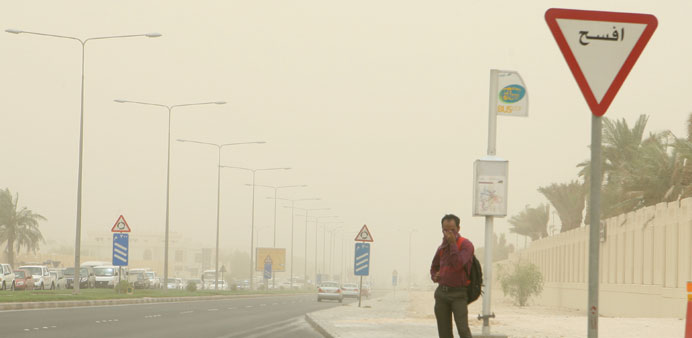
I hope that you are all feeling suitably exfoliated! The wind has been incredibly strong recently, which has been really quite unpleasant. It has thrown around a lot of dust, which seems to have made its way into everything.
When it’s this dusty, it doesn’t matter how often you clean your house, there still seems to be a thin layer of dust coating everything.
You’ve probably noticed that Qatar is rather a windy place at any time of year. The peninsula juts out into the Gulf, surrounded on three sides by the sea. Obviously the sea is flat and the land itself is also rather flat too. Certainly there are no towering mountains or dense forests, so the winds can blow quite happily, with precious little on the landscape to offer any shelter.
Obviously buildings offer shelter, but the giant towers that huddle together in West Bay don’t always protect us from the wind, they can also make things worse. When the winds rush across the country and reach the towers, the same amount of air has to get from one side of the buildings to the other. Therefore it has to squeeze down the sides of the towers, travelling at much faster speeds, in order to funnel the same amount of air in the same amount of time.
The prevailing wind in Qatar is from the northwest anyway, but at this time of year, the wind is even stronger than usual. It’s known as the Forty Day Shamal, and we can expect it to remain with us from late May to early July.
The Shamal doesn’t only affect Qatar, but much of the region from Iraq to Oman. However, it’s important to remember that it’s actually doing us a favour; as long as it blows, the humidity remains low, but as soon as it stops the humidity will soar and the weather will feel more unpleasant.
The reason our winds are usually from the northwest is because there is an area of high pressure which sits across Saudi Arabia for the majority of the year. Much like the Azores High or the Siberian High which you might have heard of, Saudi Arabia also has a dominant high pressure system. This causes the winds to circulate in a clockwise direction around the Arabian Peninsula, heading southeast down the Gulf towards Qatar. This ensures our prevailing wind direction, but the strength of the wind really picks up at this time of year, due to the weather set up further east.
At the end of spring and beginning of summer, the heat soars across Pakistan and Afghanistan. Above the scorched land, the hot air rises. This causes the pressure to drop, which sets up its own wind pattern. Winds around a low pressure circulate anti-clockwise, and as they do so, they slam into the Zagros Mountains in western Iran. If winds are blowing strongly and consistently against a mountain range, a low pressure often forms on the sheltered side of the mountains.
This is what happens at this time of year in western Iran. A thin stringy low pressure sets up, which forces winds northwestwards over the foothills of the Zagros mountains and then southeastwards down the Gulf towards Qatar.
The persistent high pressure over Saudi Arabia already ensures that we have a prevailing northwesterly wind, but this extra low pressure over western Iran adds to the strength of the wind.
The result, as we’ve seen recently, is a very powerful and relentless wind. Last weekend, the strongest gust of wind was 76kph (47mph), and the wind brought plenty of thick dust with it too. At its worst, the visibility was just 2km (1.2 miles).
The Forty Day Shamal will continue until the middle of July. It won’t be with us every single day, but more often than not it will be blowing. When it stops, you may well find yourself wishing for its return, because without it, the wind can change direction. If the wind blows in from the east, then the air will be heavily laden with moisture.
The higher the humidity, the slower water is able evaporate. This means that clothes will take longer to dry and so will wet floors. It also means that sweat evaporates slower. Sweat is one of the ways that your body tries to keep cool. As the water evaporates from your skin, it turns from liquid into gas, and this takes a lot of energy.
The energy needed for this is taken from your body, using the heat from your skin. Therefore as the sweat evaporates, you cool down. If the air has a higher humidity, then evaporation happens more slowly and therefore you sweat less and feel hotter.
As soon as the humidity rises, you’ll certainly notice it. It will feel close and very uncomfortable, a bit like being in a sauna! It’s a world away from the very dry desert wind that we’ve been seeing recently. So although you may be tempted to wish for the wind to ease, be careful what you wish for; wishes sometimes come true!
(The author is Senior Weather Presenter at Al Jazeera English channel. She can be contacted on [email protected]
or on Twitter at @WeatherSteff)