


AFP/Ottawa
Sex workers protested outside Canada’s top court yesterday as it heard arguments in support of a lower court ruling that quashed portions of a law that banned brothels.
Some 100 supporters of the three women waging the landmark legal fight waved placards outside the Supreme Court that read: “No Bad Whores. Just Bad Laws” and “Can we get some love for sex workers!”
“This case isn’t about politics or religion. It’s about the right of people in a legal occupation being able to work in safety and equality,” former prostitute and co-plaintiff Valerie Scott told the crowd.
“This case is about safety. Sex work has always been a legal occupation in Canada, but the bawdyhouse law prohibits us from working indoors, the communicating law prevents us from working outdoors.
“This puts us in an impossible situation.
“And then there’s the procurement law, which was ostensibly created to protect us ... but actually puts us in harm’s way,” she said.
But another former prostitute, Bridget Perrier, spoke out for those who object to liberalising the sex trade: “I don’t want my neighbour to open up a brothel. It would put my children at risk.”
The Ontario Court of Appeal last year said the provisions banning brothels and banning others from living off prostitutes’ earnings put sex workers at risk of harm.
Its ruling effectively paved the way for unfettered prostitution in Canada’s Ontario province.
But it upheld a ban on communicating for the purposes of selling sex.
Canada’s Justice Minister Rob Nicholson appealed the ruling, arguing that prostitution is “harmful for society as it exploits Canada’s most vulnerable people, especially women”.
Three Toronto women – Terri Jean Bedford, Amy Lebovitch and Scott – had raised the issue by challenging the law, arguing that prohibiting solicitation endangers prostitutes by forcing them to seek customers on street corners.
A lower court agreed with them, saying: “The danger faced by prostitutes greatly outweighs any harm which may be faced by the public.”
The appeals court agreed, complaining that the ban “prevents prostitutes from hiring bodyguards, drivers, or others who could keep them safe”.
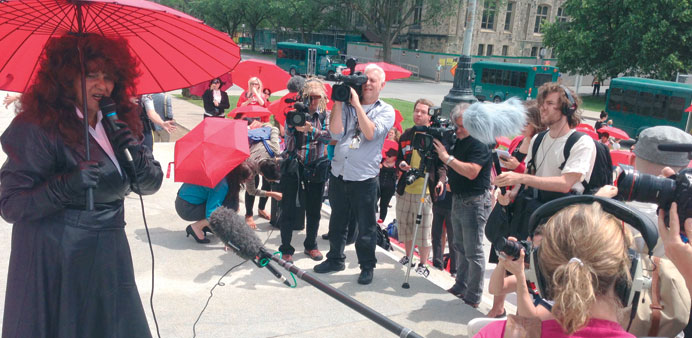
Bedford speaks to prostitution supporters and reporters at the Canadian Supreme Court in Ottawa yesterday.