


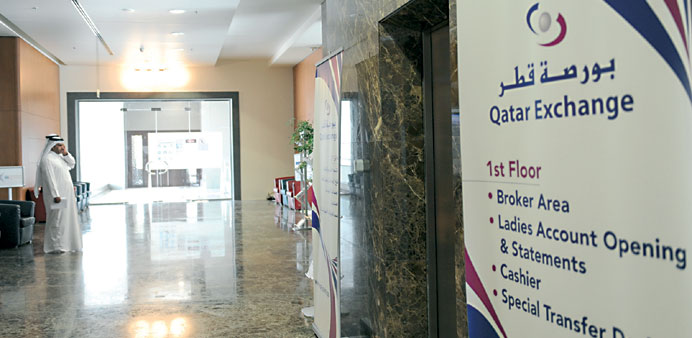
Qatar has plans to list some major government assets on its stock market, and Dubai has been considering such a move. Their new MSCI status would facilitate such listings. The presence of more foreign institutional investors could eventually change the tone of the Gulf’s stock markets, making them less vulnerable to manipulation by local speculators.
Size of fund inflows directly due to upgrade may be modest; but decision benefits region by raising profile; could support revival of IPOs in some markets; may prompt more reforms by exchanges; some see it as a spur to Saudi market opening
Reuters/Dubai
Morgan Stanley Capital International’s decision to raise the status of two Gulf stock markets in its investment indexes may buoy the entire region, helping in the long term to make it a major destination for global equity funds.
MSCI, which compiles indexes that are used as benchmarks by international fund managers, said on Tuesday it was upgrading Qatar and the UAE to “emerging market” from “frontier market” status, after they undertook reforms to make foreign investment easier.
When the change takes effect next May, MSCI-based funds are expected to add stocks from those markets to their portfolios for the first time. The UAE will have a 0.40% weight in the MSCI Emerging Markets Index and Qatar, 0.45%.
The size of fund inflows directly caused by the upgrade is likely to be modest compared to the markets’ size. Emad Mostaque, strategist at Noah Capital Markets, projected roughly $500mn of inflows for the UAE and a similar amount for Qatar. The UAE currently has a capitalisation of about $140bn and Qatar, $110bn.
But the benefits to the Gulf could go far beyond those numbers. By raising the region’s profile, MSCI’s decision may prompt many foreign investors to take a second look at it.
The presence of more foreign institutional investors could eventually change the tone of the Gulf’s stock markets, making them less vulnerable to manipulation by local speculators.
It could also help some markets revive initial public offers of shares, which have languished since the global financial crisis, and prompt some exchanges to make further reforms to attract newly available money. Some analysts speculate that Saudi Arabia could open its market more fully to foreigners.
“The MSCI move is a major game changer for the region and is going to put the region on the world investment map,” said Wafic Nsouli, head of institutional equity sales at Arqaam Capital in Dubai. “The long-term impact of the decision cannot be underestimated.”
The Gulf’s status as a destination for equity investment has for many years lagged the growth of its oil wealth and economic power. Many foreign portfolio investors have shunned the region because of geopolitical tensions.
Others have been deterred by weak regulation of the markets, poor disclosure and limits on foreign ownership; Saudi Arabia, for example, only allows foreigners to buy stocks indirectly through swap agreements or exchange-traded funds.
Perceptions have started to change over the past few years, however. The Gulf rode out the global financial crisis much more smoothly than many Western economies, causing some investors to see it as a safe haven.
Meanwhile, exchanges such as Dubai and Abu Dhabi have improved their disclosure and trading systems. Since the global crisis, Gulf states have been scrambling to expand their private sectors to reduce their vulnerability to the next plunge in oil prices; deepening capital markets is part of this effort.
One hope of many brokerages is that greater liquidity created by the arrival of more foreign funds will let the markets resume a steady stream of IPOs, which largely halted in the UAE after the global crisis shrank trading turnover.
The last new listing in Dubai occurred in early 2009 and in Abu Dhabi, late 2011. When Abu Dhabi healthcare firm Al Noor Hospitals announced this week that it would raise $320mn-$390mn in an IPO, it chose London rather than its local market.
Qatar has plans to list some major government assets on its stock market, and Dubai has been considering such a move. Their new MSCI status would facilitate such listings.
There are also hopes that access to a larger pool of foreign funds could, in the long term, change the behaviour of both companies and exchanges.
MSCI’s upgrade of Qatar was a surprise to many fund managers because its companies still maintain many restrictions on foreign ownership of their shares.
But days before MSCI’s decision, the Qatar Exchange announced that some major companies had applied to increase the number of shares available to foreign investors.
The new limits are still not high - in many cases, they will be 25% of a company’s market capitalisation, up from 25% of its free float - but MSCI said it was satisfied by Qatar’s commitment to future change.
Rashed al-Baloushi, chief executive of the Abu Dhabi Securities Market, said the emirate would continue reforming its market rules and infrastructure.
“It took us five to six years to be upgraded to emerging market status and to get to the next stage of developed market the criteria are higher, and that is more challenging,” he said.
One of the biggest potential effects of the MSCI decision could be to spur the opening of the Saudi Arabian market, the Arab world’s biggest, to direct investment by foreign institutions, if Riyadh believes it risks missing out on a surge of fund inflows into the Gulf.
“This puts additional pressure on Saudi Arabia to accelerate its Qualified Investor programme and we now believe this is likely over the summer,” said Mostaque.
Saudi officials have been considering introducing the Qualified Investor programme, which would allow foreigners limited direct investment in Saudi shares, for years. They have not announced a date for it, partly because they are wary of destabilising their market, but preparations are at an advanced stage so the opening could occur quickly if a decision is made.
Promotion will spur more local market listings: DFM chief
The promotion of the UAE to emerging markets status by index provider MSCI Inc should help attract a broader range of investors to the country’s stock exchanges and spur more public listings, the chief executive of the Dubai bourse said yesterday.
MSCI overnight reclassified the UAE and Qatar as emerging markets, from frontier, a move that is expected to trigger hundreds of millions of dollars in fresh foreign inflows from global funds tracking these indices.
“This will definitely consolidate the UAE’s position as one of the biggest markets in the region attracting foreign flows,” Essa Kazim, the managing director and chief executive of the Dubai Financial Market, told the Wall Street Journal in a telephone interview.
As liquidity increases, Kazim hopes that more local companies may choose to list on the country’s bourses. “A more diversified investor base may prove to be an attraction for them,” he said.
Already this year the two local markets-Dubai and Abu Dhabi-have rallied sharply on the back of a fast improving outlook for the country’s economy, underpinned by stronger trade and tourism and the UAE’s safe haven status. Dubai’s benchmark stocks gauge is among the top performers in the world in 2013, rising 45%, while neighbour Abu Dhabi’s gauge has added 36% to date.
The promotion, which will be effective in May 2014, is likely to provide a further boost to UAE markets as investors position ahead of that, Kazim said.
“We also hope to see a more diversified investment profile-a mix of both hedge funds as well as a longer-term profile of investors,” the Dubai bourse executive added.
Borse Dubai, a government investment vehicle, owns an 80% stake in DFM, while the balance is publicly listed. It also has a 20.6% stake in the London Stock Exchange and holds 18% of the Nasdaq OMX Group shares, according to Zawya.com.
Dubai has over the past few years pushed hard to attract foreign investment, building the world’s tallest tower and palm-shaped islands as showcase attractions, but the global financial crisis in 2008 waylaid a lot of those plans as the emirate struggled to repay billions of dollars in debt.
But a resurgence in trade and tourism in the recent past has allowed the Gulf state to revisit some of its growth plans. In light of this, the MSCI promotion comes just at the right time for the country.
Some analysts however warn that while emerging market status may force foreign funds to look at the UAE, flows may remain light as investors would be cautious due to the lack of diversity in terms of listed companies.
Real estate and bank stocks dominate the two local bourses with the likes of Emaar Properties among the top attractions. The country’s biggest listed company, Etisalat, doesn’t even allow foreigners to buy its shares and some of its other big firms remain mostly privately-owned by large local families.