


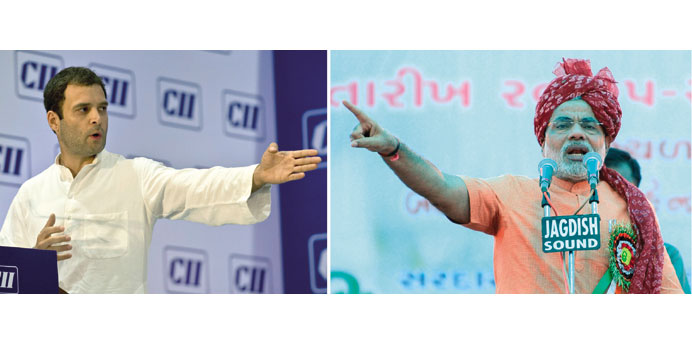
Gandhi and Modi: though neither have yet been named the prime ministerial nominee of their parties, it is clear both will lead the charge ahead of the next general election.
AFP/New Delhi
Narendra Modi’s elevation as opposition chief for next year’s national elections sets up a contest between a Hindu nationalist who must shed the taint of religious riots and the reluctant prince of the Gandhi dynasty.
Modi, the chief minister of Gujarat known popularly as “NaMo”, was named election committee chairman for the Bharatiya Janata Party (BJP) on Sunday ahead of polls scheduled for the first half of 2014.
The choice marked a new era for the leadership of the BJP, which came of age in the 1990s, and lays the stage for what is expected to be a bitter and intensely personal rivalry.
Rahul Gandhi, 20 years younger than Modi at 42 and with a vastly different background and personality, will be the BJP man’s opposite number as election co-ordinator for the ruling Congress Party.
While neither man is guaranteed to become prime minister even if their party wins the right to form the next coalition, they will front the campaigning in the world’s biggest democracy.
“Our aim should be a Congress-free India,” Modi told cheering supporters after his appointment. “If we can free this country of the Congress, all our problems will be solved.”
Beneath the display of unity at the BJP meeting in Goa, Modi’s elevation has divided his party and coalition allies - an effect likely to be repeated on the electorate.
BJP patriarch L K Advani, who built the party into the only national opposition to Congress, snubbed the conclave and then issued a shock resignation letter yesterday.
“Most BJP leaders are concerned just with their personal agendas,” Advani wrote in the letter in an apparent reference to his one-time protégée.
The Indian Express noted yesterday how “the BJP has pledged to unite behind its most divisive leader” in an editorial that analysed the “spectacular” rise of the son of a tea-stall owner.
Modi’s immediate challenge will be to avoid a messy internal power struggle and keep his party together. He must then persuade voters he is fit to lead a secular nation which was born amid religious violence.
Modi remains tarnished by 2002 riots in Gujarat in which as many as 2,000 people, mostly Muslims, died in an orgy of killing shortly after he came to power in the state.
While he has never been convicted of any offence, one of his former ministers was jailed last year for directing some of the violence and the Supreme Court once compared him to Nero, the emperor who fiddled while Rome burned.
Boycotted for a more than a decade by European powers, he was denied a US visa in 2005 because of “severe violations of religious freedom” in Gujarat, and has not visited since.
No party has had an absolute majority in parliament since 1989 and Modi could be more of a hindrance than a help in trying to form a ruling national alliance, analysts say.
In an editorial yesterday, The Times of India stressed Modi’s appeal among the young and his promise of strong leadership.
“To take the BJP to victory in 2014 he will however need to unveil a hitherto hidden side: the ability to build coalitions,” it said.
Under diffuse leadership and with an ill-defined policy agenda, the BJP has made little headway in recent years, losing its only toehold in the south of the country in state elections in Karnataka last month.
Rahul Gandhi, whose great-grandfather, grandmother and father were prime ministers, struggles to fire up his party’s grassroots supporters. Modi inspires feverish devotion from his followers.
Gandhi declared recently he was not “a hard-nosed politician” and he is still seen as a reluctant leader despite being named Congress vice president and chief election strategist earlier this year.
Since appearing before business leaders in early April, Gandhi has not made any speech of note, while Modi has criss-crossed the country burnishing his image as an energetic corruption-fighting economic reformer.
On social media, Modi posts his speeches and can rely on an army of cheerleaders; Gandhi has yet to open a Twitter account.
Amid the speculation about a battle of the bachelors - both are unmarried - The Hindu newspaper sounded a note of caution, counselling that neither man had been named as prime ministerial candidate.
“NaMo’s frenzied fan clubs will do well to understand that their hero has some way to go before he becomes the face of 2014,” it concluded.