


The elimination of tuberculosis (TB) by 2050 worldwide was the subject of a recent Academic Health System (AHS) lecture held at Hamad Medical Corporation (HMC).
This was the third lecture in a series bringing the latest medical research to Qatar to improve patient care, highlighting the latest innovations for health professionals, a central focus for the AHS.
The lecture was delivered by Qatar-based infectious diseases expert Dr Laith Abu-Raddad, associate professor of public health and director of biostatistics, epidemiology and biomathematics research core, Infectious Disease Epidemiology Group at Weill Cornell Medical College in Qatar (WCMC-Q).
WCMC-Q is one of the eight members of the AHS. “Probably, no infection has killed more people than TB over human history. It is a communicable disease with a long and complex history and has affected humankind for thousands of years. To eliminate TB, we need to address every aspect of the infection pathway with interventions to provide the highest impact in terms of TB control,” Dr Abu-Raddad said.
A deadly but preventable and curable disease, TB is caused by the bacteria mycobacterium tuberculosis and most commonly affects the lungs.
The symptoms of active TB on the lungs are coughing, discharging saliva mixed with mucus or blood, chest pain, weight loss, fever and night sweats. The disease can also affect other body parts, including kidneys, spine and brain.
Recent international research collaborations have focused on addressing active TB as well as latent infection.
Dr Abu-Raddad said WCMC-Q collaborated with Fred Hutchinson Cancer Research Centre in the US, University of Washington and World Health Organisation (WHO) to conduct research on the impact of new approaches for TB interventions such as developing new vaccines, faster diagnosis rates, novel treatment regimens and mass vaccination campaigns in endemic countries.
The research acknowledges that achieving the goal of TB elimination by 2050 will require simultaneous and multiple interventions to move from cure and control to TB elimination.
Worldwide figures reveal that in 2011, around 8.7mn people fell ill and 1.4mn died of TB, according to WHO.
In 2012, there were 511 new TB cases in Qatar, according to HMC Infectious Diseases unit head and National Tuberculosis Programme manager Dr Abdullatif al-Khal, who clarified that the increase in TB cases was primarily due to the influx of people from outside Qatar.
“Most of the people who develop active TB here are likely to have been infected back in their home countries,” he said.
Over the past 10 years, there has been a decrease in TB cases in the Qatari population - from 48 in 2003 to 14 last year.
“We make sure that patients who have TB, or those being given preventive therapy, undergo the directly-observed treatment, short course. Patients are monitored closely and need to swallow pills in the presence of nurses to ensure that the whole course of treatment is completed. This is an essential part of the national TB control programme,” Dr al-Khal explained.
To ensure that all TB patients diagnosed in Qatar are able to benefit from access to high-quality and patient-centred treatment, the HMC is developing an integrated Infectious Diseases Hospital at Hamad Bin Khalifa Medical City, which will include the National TB Programme.
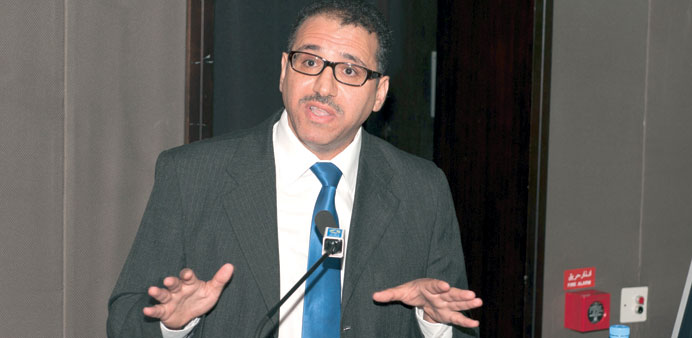
Dr Abu-Raddad makes a point.