


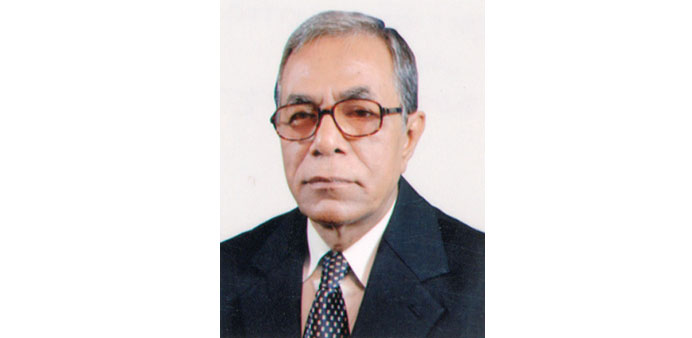
Tarique Rahman: Facing graft charges
By Mizan Rahman/Dhaka
Bangladesh President Abdul Hamid has refused to entertain two petitions from the ruling party for presidential clemency.
Hamid has instructed president secretariat officials to send the pleas to “deep fridge”.
The sources, quoted by a newspaper, said the president has taken a tough position on his authority to pardon a convict as the previous Bangladesh Nationalist Party (BNP) and the present Awami League governments allegedly misused the constitutional provision for political purposes, putting the previous presidents in embarrassing situations.
At least two applications for clemency had reached the president’s office.
The home minister on November 14 last year told parliament that 25 people had been given the presidential clemency since 1972. Among them 21 were on death row who got the amnesty during the rule of the present Awami League government.
“I will not exercise the authority of clemency in my tenure. Send those (applications) to the deep fridge,” a source in an authoritative position in the president’s secretariat quoted Hamid as telling his secretary.
“I am embarrassed by the media reports on clemency applications although every citizen has the right to do so,” the president told his personal staff.
“I will not do anything that will tarnish the image of the president’s office,” said Hamid, who was elected the president on April 22.
According to Article 49 of the constitution, the president can pardon any convicted person as suggested by the prime minister. The head of the state is not free to exercise this authority, but he can withhold the government’s recommendations.
Anyone can apply for presidential clemency through the ministries of home and law. Applications can also be sent directly to the president’s office through the jail
authorities concerned.
Of the clemency applications submitted at the president’s office, one was from Yasin alias Titu, son of KDS Group chairman Khalilur Rahman and a convict in the murder case of Indian national Zibran Tayebi.
Yasin killed Tayebi on June 9, 1999. The appellate division of the Supreme Court on August 1 last year upheld the lower court’s ruling of life
imprisonment.
On October 10, 2011, Yasin returned from the UK and surrendered to the court in the hope of getting an amnesty. Since then he has been in jail.
In another case, two relatives of State Minister for Religious Affairs Shahjahan Mia – Kala Mridha and Jakir Mridha of Patuakhali – have applied for the president’s mercy. The home ministry has already placed recommendations in their favour.
Another person, who killed his wife and has links with a section of the officials of the president’s office, has applied for amnesty without informing the home and law ministries.
Hamid has already turned down the appeal.
The Awami League has been criticised for having 18 people pardoned by immediate past president Zillur Rahman. They were convicted of killing a nephew of former deputy minister Ruhul Quddus
Talukder in Natore.
Rahman pardoned them as the government considered the murder case a “false one”, plotted to destroy the whole Awami League leadership in Natore district.
Rahman had pardoned the sentence of life imprisonment of AHM Biplob, son of Lakshmipur municipality Mayor and Awami League leader Abu Taher. Biplob was also given life sentence in another murder case, but the late president reduced that sentence to 10 years.
Abdul Jabbar, an adopted son of Abu Taher, was sentenced to 30 years in jail but Zillur reduced it to 10 years. Jabbar now applied for mercy.
The military-backed caretaker government pardoned one person in 2008.
Two were given the presidential clemency in 2005 during the then BNP rule.
The Awami League, then in opposition, criticised the clemency to fugitive BNP leader Mohiuddin Jintu, living in Sweden, as an act of destroying the rule of law in the country.
Bangladesh President Abdul Hamid
Bangladesh asks Britain to send back Zia’s fugitive son
Agencies
Dhaka
|
B |
angladesh has asked Britain to repatriate the fugitive elder son of former premier Khaleda Zia to face trial on massive corruption charges.
Tarique Rahman, opposition Bangladesh Nationalist Party’s senior vice president, is wanted on charges of graft and a deadly grenade attack.
A Dhaka court on May 26 issued a warrant ordering Rahman to face trial on graft charges brought by Anti-Corruption Commission (ACC) during the 2006-2008 emergency rules under the army backed interim government.
“Our high commission in London has handed over a letter to the British authorities seeking Tarique Rahman’s return ... The copy of the court’s arrest warrant ordering his arrest was also provided to the British authorities,” a senior foreign ministry official told a news agency.
The official said the letter was sent to the British Foreign Office last week also pointed out that a Dhaka court ordered Bangladesh foreign ministry to execute the warrant engaging Interpol as Rahman was living in London since 2008.
The British High Commission officials in Dhaka were unavailable for comments on Dhaka’s request.
Rahman is also being tried in absentia by another court on charges of masterminding the August 21, 2004 grenade attack on a rally of the then opposition Awami League of incumbent Prime Minister Sheikh Hasina.
Rahman maintained a low profile in exile as he was charged under a series of graft and criminal cases.
The warrant came a week after he was seen at a BNP meeting in East London recently demanding restoration of caretaker government system for election oversight.
He also urged expatriate Bangladeshis to mount pressures on the ruling Awami League on the issue as the BNP was spearheading a massive street campaign saying no election under the party government would be acceptable.
Rahman’s younger brother Arafat Rahman Koko also fugitive is currently living in Bangkok apparently to evade justice for siphoning off huge amount money during the 2001-2007 BNP rule.
ACC earlier said it recovered $1.63mn which was siphoned off by Koko while a Dhaka court last year handed him down six years of imprisonment after trial in absentia for misappropriation of state funds.
BNP has consistently been alleging that the Zia’s sons were being victimised for political vengeance while the issue appeared as a crucial factor ahead of the next year’s general elections.
The World Bank recently released a report mentioning the alleged embezzlement of millions of dollars by Koko as “an example of stealing national assets”.