


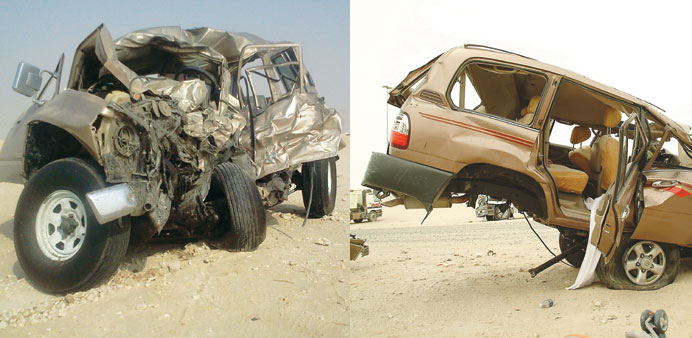
The mangled remains of a large SUV involved in a fatal highway accident, caused by balloon tyres, in Qatar. RIGHT: What is left of another SUV that crashed on a Qatar highway because of balloon tyres.
By Bonnie James/Deputy News Editor
|
|
At a time when Qatar has launched a new road safety campaign under the brand “One Second”, the indiscriminate use of balloon tyres - meant only for sand or desert - on large SUVs plying the highways is contributing significantly to many fatalities and injuries.
“Large SUVs constitute the majority of vehicles involved in road traffic accidents and an overwhelming number of them run on balloon tyres with very little road traction,” a safety expert told Gulf Times on condition of anonymity.
Qatar has banned the import and use of balloon tyres (for passenger vehicles) unless accompanied by a certificate of conformity with requirements specified in technical regulations GSO 51/2007, GSO 52/2007 and GSO 53/2007.
Through an announcement in March last year, the Traffic Department further extended the deadline for enforcing the ban.
“The balloon tyres commonly seen on large SUVs on Qatar roads have the tread run parallel to the tyre, offering very little traction on road. As effective as they are in the precise condition they were designed and tested for, they are incredibly dangerous when used on the highway,” he explained.
In the past, most of the balloon tyres sold in Qatar had the warning message “Tyre design for safari in desert only. Not for highway service”, imprinted on the outer wall, but of late most manufacturers have dispensed with this.
The sidewalls of balloon tyres are as soft as possible and many well-known brands do not have steel belts to keep the weight down. These are perfect on the sand where a balloon tyre needs to spin over sand without biting or digging in.
“However, drive SUVs with these tyres on the highway and you have a recipe for disaster – a scenario we so often encounter on our roads. Under emergency braking conditions, which are quite often in Qatar, these tyres contribute significantly to many road fatalities and injuries,” the expert pointed out.
Motorists who want to install balloon tyres on their SUVs should ensure they meet the GCC and Qatar standard, he suggested. Never use a tyre without the manufacturing date on its sidewall.
Usually the date will be stamped, starting with the acronym DOT, followed by two digits that denote the plant of manufacture, and four-digit week + year (first two digits representing the week and the other two the year) .
If balloon tyres are to qualify for the GCC and Qatar safety norms, the following are the standards that should be stamped on to the outer sidewall: “Tyre designed for highway and desert services”, Temperature grade: A, traction: AA, type of tire: Radial (R), speed symbol: S (180 and higher), and date of production.
The universal rating mechanism of tyres is the “Uniform Tire Quality Grading System”, a US standard which requires manufacturers to grade their products in the categories of treadwear and traction and temperature.
Treadwear grades are an indication of a tyre’s relative wear rate. The higher the treadwear number, the longer it should take for the tread to wear down. A control tyre is graded 100 and all other tyres are compared to this. A tyre grade of 200 should wear twice as long as the control tyre.
Traction grades denote a tyre’s ability to stop on wet pavement. A higher-graded tyre should allow a vehicle to stop on wet roads in a shorter distance than a tyre with a lower grade. Traction is graded from highest to lowest as AA, A, B and C.
Temperature grades indicate a tyre’s resistance to heat. Sustained high temperature (for example, driving long distances in hot weather) can cause a tyre to deteriorate, leading to blowouts and tread separation.
“From the highest to the lowest, a tyre’s resistance to heat is graded as A, B or C and almost 60% of the tyres available in the market are rated B. For Qatar conditions, nothing less than A should be considered,” the expert added.