


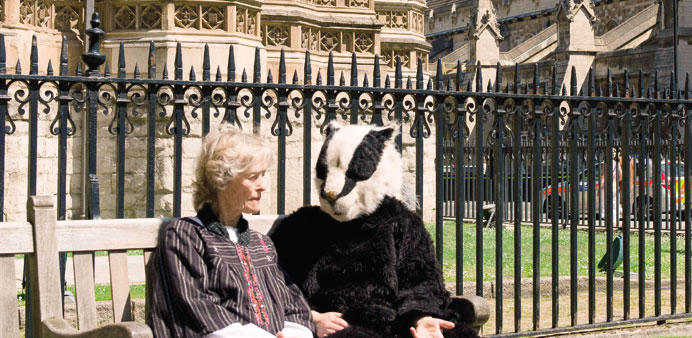
Actress and founder of the Born Free Foundation Virginia McKenna talks with a woman in badger costume outside the Houses of Parliament in central London yesterday during a day of opposition to the government’s badger cull plans. The cull, which started in two areas of southwest England on June 1, will see up to 5,000 badgers killed in a bid to combat tuberculosis in cattle.
Guardian News and Media/London
Only three UK supermarkets - Waitrose, Marks Spencer and Asda - can guarantee they will sell milk that does not come from dairy farms inside zones where badger culls are due to take place, according to a survey by campaigners.
The survey also revealed that milk certified as organic will not be guaranteed as coming from farms outside the cull zones in Somerset and Gloucestershire.
“Customers should be given choice a choice to buy cage-free eggs and a choice to buy badger-friendly milk,” said Philip Mansbridge, of Care for the Wild, which ran the survey.
“I think when they are given that choice, many will take it.”
Ministers have approved pilot culls of 5,000 badgers in a drive to curb rising levels of tuberculosis in cattle, a disease also carried by badgers.
More than 37,000 cattle were slaughtered in 2012 at a cost to taxpayers of over £100mn.
The Environment Secretary, Owen Paterson, insists that culling is an essential part of controlling bovine TB, along with cattle movement restrictions and research on vaccination. But opponents argue the cull is an expensive distraction and could make matters worse.
“A cull would be bad for badgers, bad for farmers and bad for taxpayers,” said shadow environment secretary, Mary Creagh. “We need a science-led policy to manage cattle movements better and prioritise badger and cattle vaccination to tackle bovine TB instead of a cull.”
A YouGov opinion poll commissioned by the National Farmers Union (NFU), which backs the cull, showed 34% of the English and Welsh public opposed the policy, 29% supported it, while 37% expressed no opinion.
“The results show a badger cull is not a big issue for the vast majority of the public,” said NFU vice-president Adam Quinney. “But to the thousands of farming families living with the constant threat of TB, tackling this disease is the most important issue in their lives.”
The Care for the Wild survey asked supermarkets to identify milk sold in their stores that would not come from dairy farms in the Somerset and Gloucestershire cull zones.
Waitrose, Marks and Spencers and Asda said their own brand milk would not come from these areas.
The Co-operative said it owned no farms in the pilot cull areas. But a spokesman added: “As we do not operate a segregated milk supply chain, in common with other retailers, a small proportion of our milk may have come from farms in the proposed trial areas.”