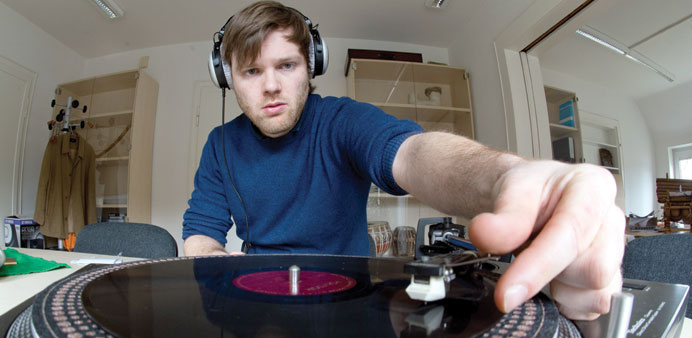
Laying a needle in a groove: Samuel Mund, a doctoral student at the University of Hildesheim and CWM staffer, working at the Center for World Music at the University of Hildesheim in Germany on the digitisation of nearly 4,000 old shellac records of traditional Iranian music. “I tried to go there free of prejudice,” he said of his first trip to Tehran. Photograph: Julian Stratenschulte
By Michael Evers
Despite inter-government discord, German technicians are working harmoniously with the Music Museum of Iran (MMI) to digitally preserve thousands of historic sound recordings that have lain dormant in Tehran archives for years.
The project has laid the basis for long-term collaboration between Hildesheim University’s Center for World Music (CWM) and the University of Tehran.
Musicologists are anxiously awaiting digitisation of the shellac records, the oldest of which were cut more than 100 years ago in Hanover, Germany.
The project came about by chance. After experts at the University of Hildesheim, which is located near Hanover, had successfully preserved old sound collections in Egypt, an Iranian doctoral candidate in Hildesheim recalled the record collection at the MMI in Tehran.
Museum officials quickly showed interest and sent a delegation to Hildesheim, said CWM director Raimund Vogels. “Trust developed very fast,” he noted.
Germany’s Ministry of Foreign Affairs and the Lower Saxony Foundation, which promotes art, culture, education and science in the German state of the same name, are supporting the project to the tune of €60,000 (about $78,000).
It is being closely supervised by both countries, and the Germans have stipulated that no German funds go to Iran, which is subject to international sanctions because of Tehran’s nuclear programme.
Some 3,000 shellac records dating from 1906 to 1932 are to be cleaned and then digitised. “Iranian rulers at the time were technology-mad and fascinated by everything that came from the West,” Vogels says.
German recording technology arrived for the first time in Tehran in a convoy or caravan from Istanbul shortly after 1900. The first Iranian gramophone records were manufactured in 1906 in Hanover from pressings made in Iran, then still known as Persia.
The inventor of the gramophone, Emile Berliner, a German emigrant to the United States, had begun mass production of the discs there a few years earlier.
Most of the old Iranian recordings are of courtly, erudite music by small oriental ensembles. “What’s marvellous about the recordings is that they’re of top talents,” Vogels remarked.
The work of the era’s great masters, mainly passed down through their pupils or by memory, is now available as well in sound recordings, he said, adding that the MMI’s visitors were delighted that the voices of their forebears had been brought back to life.
One of the project’s supervisors is Samuel Mund, a doctoral student at the University of Hildesheim and CWM staffer.
“I tried to go there free of prejudice,” he said of his first trip to Tehran, although many of his acquaintances had been dismayed by his plans to work in what the United States has labelled a “rogue state.”
“I had nothing to be afraid of, and I’m greatly interested,” Mund stressed. Once in Tehran, he began training his Iranian colleagues in English. A multilingual databank of the registered music is planned.
The digitisation project — using a DJ record player modified for 78-rpm shellac records, special needles, an amplifier and digital converter — is to be completed by year’s end. The main problems came from an unexpected source: unearthed power lines in the MMI interfered with the recordings.
The cables were replaced. “We’d be pleased if this collaboration better aquaints musicians and music lovers from all over the world, especially Germany, with Iranian music,” said Farzin Pirouzpey, the MMI’s deputy director.
“We believe that the Music Museum of Iran can better present itself internationally as a notable music research institution through co-operation with the Center for World Music.”
The German-Iranian collaboration is already benefiting students: The universities of Hildesheim and Tehran are currently developing a joint master’s programme that will provide for a regular student exchange. – DPA
Photos of performers of traditional Iranian music on the walls of a gallery at the Music Museum of Iran (MMI) in Tehran. Photograph: Mohamed Moradkhani/MMI