


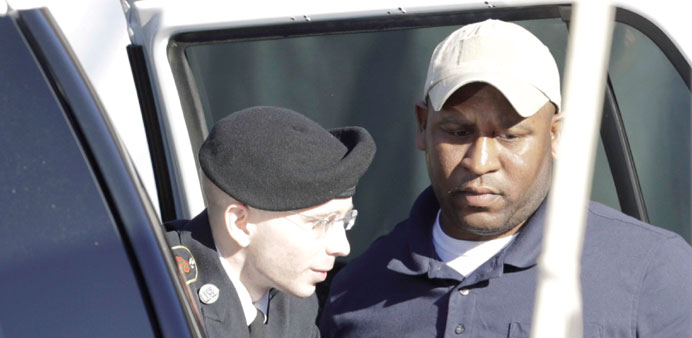
US Army Private First Class Bradley Manning (left) arrives for day two of his court-martial at Fort Meade, Maryland yesterday.
Reuters/Fort Meade, Maryland
An Army investigator testified yesterday he found no evidence that a soldier accused of the biggest breach of classified information in US history hated his country or had any terrorism-related material on his laptop.
The investigator’s testimony on the second day of Private First Class Bradley Manning’s court martial came after prosecutors told the judge on Monday that the soldier had been driven by arrogance to leak more than 700,000 documents, combat videos and other data to the anti-secrecy website, WikiLeaks.
Lawyers for the 25-year-old Manning described the former intelligence analyst in Iraq as naive but well intentioned in wanting to show the American public the reality of war in Afghanistan and Iraq.
The Manning case has pitted civil liberties groups that want more transparency about military and diplomatic affairs against the government, which accuses Manning of endangering lives and souring sensitive diplomacy by leaking classified information.
Mark Johnson, a civilian digital forensic examiner with the US Army’s Computer Crimes Investigation Unit, told the court at Fort Meade, Maryland that he found three “items of interest.” They included digital slides, WikiLeaks contact details and a video on a laptop seized from Manning’s living quarters at an Army base in Baghdad in 2010.
He did not describe the contents of the documents. One of Manning’s lawyers, Major Thomas Hurley, asked Johnson if he had found “anything indicating hatred of America.”
“No, but we would have noted it,” Johnson replied. “We didn’t find it.”
The search did not turn up any materials related to terrorism, Johnson testified.
Jury selection starts in mobster trial
Jury selection was to begin yesterday in the trial of James “Whitey” Bulger, an ageing mobster who spent 16 years hiding in broad daylight in California and became the inspiration for a gritty Hollywood flick.
Bulger, 83, is charged with 19 murders in the 1970s and 80s in Boston and also faces federal racketeering charges.
His case gives new meaning to the term long arm of justice: a Bostonian nabbed way out west after many years on the lam, thanks to a tipoff from an actress who was once Miss Iceland, calling the FBI from Reykjavik.
Bulger was arrested in 2011 in Santa Monica, California, where he had been living under an assumed name with long-term girlfriend Catherine Greig, then 60. At the time, Bulger was on the FBI’s ten most wanted fugitives list.