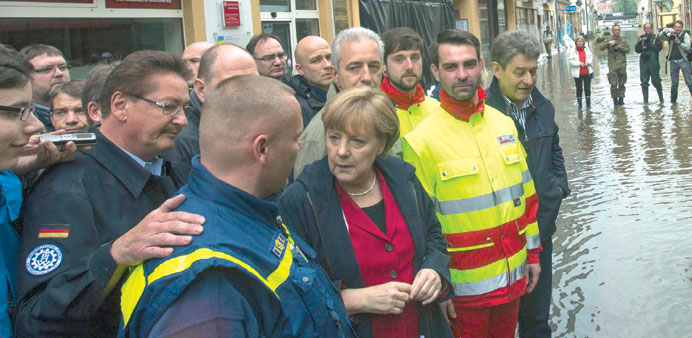
Merkel speaks with rescue workers as she inspects a flooded street near the Elbe river in the east German town of Pirna.
AFP/Passau, Germany
Chancellor Angela Merkel has pledged 100mn euros ($130mn) in emergency aid for flood-ravaged areas as surging waters that have claimed at least 11 lives and forced tens of thousands of evacuations across central Europe bore down toward Germany.
Heavy rains have turned vast regions into lakes, cut off villages, severed transport links and left historic city centres under muddy brown water. The inundations have also brought back dark memories of devastating floods that killed dozens 11 years ago.
The largest volumes of floodwater have travelled down two of Europe’s great river systems: the Danube, which runs from Germany through Austria and central Europe into the Black Sea, and the Elbe, which flows from the Czech Republic through Germany into the North Sea.
Merkel travelled by helicopter over the flood zone and visited three impacted areas, starting in Passau, Bavaria, where the Danube meets two other rivers and peaked late on Monday at 12.9m, the highest level since 1501.
The chancellor vowed the emergency cash would be disbursed in an unbureaucratic way because “what’s important now is that the aid quickly reaches the people”.
“Even if the water level is slowly retreating, the effects will be felt for a long time,” she told reporters. “Therefore 100mn euros of emergency aid is available from the state (of Bavaria) and the federal government.”
The property damage in Passau alone was estimated at 20mn euros ($26mn) by the city mayor.
Some people have paddled canoes down flooded streets in Passau, where drinking water, power and phone services were cut. Elsewhere stranded residents were evacuated from their soggy homes by rescue personnel using inflatable boats.
“The damage and the loss of income is a long-term matter. And that’s why our support will not cease,” said Merkel, who faces an election in less than four months and was later photographed helping fill sandbags.
Across the region, the official death toll rose to 11 as Czech emergency services recovered the body of a man from the swollen Male Labe river in the northern Krkonose mountain range, near the border with Poland.
The deluge killed seven others in the Czech Republic, including a woman who was hit by an uprooted tree as she walked her dog. Two others died in Austria and one in Switzerland. Several more people were missing.
Across much of the swamped region, rail, road and river traffic links were cut, crops destroyed, schools and factories closed and hospitals evacuated.
In Prague, the flood water hit its highest level yesterday after inundating the city centre, displacing more than 8,000 people and forcing the night-time evacuation of the city’s zoo.
Tourists mingled with locals on Prague’s bridges, taking pictures of the high water, sandbags in the doorways, anti-flood defences and the 14th-century Charles Bridge which remained closed to the public.
Watching from another bridge, Jindrich, a man in his 50s willing to give only his first name, said the flood “looked better than in 2002” when 17 people died across the Czech Republic. “It has turned out quite okay.”
Prague has installed anti-flood walls along 17km of river front, said fire brigade spokeswoman Nicole Zaoralova.
The mass of water was headed downstream to Germany, where cities on the Elbe, including Dresden and Magdeburg, scrambled to prepare for potentially massive floods.
In Magdeburg, authorities declared a state of emergency and said they expected the river, normally at 2m, to rise to almost 7m – higher than in 2002.
In all, Germany deployed some 43,000 fire fighters and 4,000 troops in four states, securing dykes with sandbags, and providing food, shelter and clothes for displaced people.
Transport Minister Peter Ramsauer expected the damage to German road and rail infrastructure to reach hundreds of millions of euros.
Several events were cancelled, including a music festival dedicated to Baroque composer Georg Friedrich Haendel planned for June 6-16 in the eastern city of Halle, where troops were helping reinforce river flood defences.
In the capital Berlin, away from the flood zone, politicians of two parties scrapped plans for river cruises, arguing that this would be in bad taste at a time when cities are under water.
President Joachim Gauck declared that “the fate of the victims moves me ... I’m glad to hear that they are standing united in solidarity and determination in these hours and are receiving a lot of assistance and support”.
Austria mobilised more than 20,000 firefighters, police and rescue workers and 800 soldiers in areas along the Danube.
In Hungary, Prime Minister Viktor Orban declared a state of emergency and mobilised more than 20,000 emergency and military personnel ahead of the arrival of the peak of the Danube flood, expected in western areas today and in Budapest by the weekend.