


By Bonnie James/Deputy News Editor
Qataris have a high level of trust in their countrymen and Arabs who share their language and social values and much lower trust in Westerners and non-Arab migrant labourers who are dissimilar in both language and social values, a survey has found.

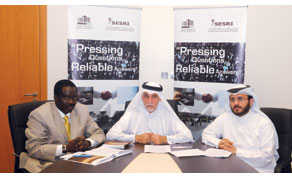
Dr al-Emadi flanked by Dr Diop and al-Ansari at the announcement of the survey results yesterday. PICTURE: Shemeer Rasheed
The results of ‘From Fareej to Metropolis: A Social Capital Survey of Qatar,’ conducted by Qatar University’s Social & Economic Survey Research Institute as a first for the GCC region were announced yesterday.
“It is a universal trait that people generally have more trust in those from the same culture and speak the same language,” SESRI director Dr Darwish A H al-Emadi said.
On a scale from 0 to 10 where 0 denotes no trust at all and 10 represents complete trust, Qataris gave high ratings to fellow countrymen (mean rating of 8) and Arab expatriates (6.1).
Excluding migrant labourers, Qataris gave the lowest trust ratings (3.6) to Western expatriates, whereas expatriates from other nationalities scored a higher mean rating of 4.4.
With regard to migrant labourers, Qataris trust Arabs moderately (4) as compared to others (3.1). White-collar expatriates showed a high trust in Qataris (7.4), Arab expatriates (6.4) and to a lesser extent in Westerners (5.3) and other expatriates (5.6).
Compared to Qataris, white-collar expatriates gave higher trust ratings to migrant labourers (5.2 for Arabs and 4.7 for other nationalities). Migrant labourers, meanwhile, showed high trust in their peers, especially non-Arab labourers (7.2), Qataris (7.2) and other expatriates (7.3).
“Social capital embodies the relationships that connect people outside the family to society as a whole, it is the glue that holds the society together,” explained researcher Majed Mohamed al-Ansari.
This is seen in social interaction between members of the same group and between different groups, membership and involvement in civil society, community and religious organisations and other indicators of social activity.
The survey conducted between February 21, 2011 and March 15, 2011 using Computer Assisted Personal Interviewing technology, covered 2,268 respondents above the age of 18, including 800 Qataris, 637 white-collar expatriates (mostly Arab) and 831 migrant labourers.
“The rest of the year was spent on analysing the data and finalising the results,” said Dr al-Emadi while pointing out that social capital studies is a new line that flourished in the West during the last decade.
SESRI’s head of research Dr Abdoulaye Diop stated that this study sets the baseline data for any future survey on social capital, a very important component of sustainable development, an integral part of Qatar National Vision 2030.
The survey asked a variety of questions pertaining to social capital and civic engagement, including frequency and method of contact with friends, family and co-workers, use of mobile phones and Internet, social networking sites and participation in neighbourhood, community and work-related activities.
“We intend to repeat the survey every three years in the next decade considering that Qatar is going to host the 2022 FIFA World Cup and the related projects will bring in more people,” Dr al-Emadi said.
The survey was conducted through a grant from the third cycle of Qatar National Research Fund’s National Priorities Research Programme.
The team which prepared the executive summary also involved Sesri senior researcher Dr Kien Trung Le and University of Michigan’s Dr Mark Tessler, Dr Jill Wittrock, and graduate student Ashely Jardiina.