


A staggering 88% of young Qataris say they are happy with the direction in which their country has been heading while looking back over the last five years, according to the fifth annual ASDA’A Burson-Marsteller Arab Youth Survey (AYS), which was released in Doha yesterday.
Qatari youth are also positive about how the Gulf state is competing on an international stage, with 60% agreeing with the statement - “I feel my country can compete on the world stage” - compared to 54% of Arab youth overall.
The survey, conducted by ASDA’A Burson-Marsteller, a leading public relations consultancy in the Middle East and North Africa (Mena) region, is aimed at providing reliable data and insights into the attitudes and aspirations of the region’s 200mn-strong young population, informing policy- and decision-makers in both the public and private sectors.
International polling firm Penn Schoen Berland completed 3,000 face-to-face interviews with Arab nationals - both men and women - aged 18-24 years in the six GCC countries - Qatar, the UAE, Saudi Arabia, Kuwait, Oman and Bahrain - Iraq, Egypt, Jordan, Lebanon, Libya, Tunisia and three new additions this year - Morocco, Algeria and Yemen. The survey was conducted between December 2012 and January 2013.
For the fifth edition of the survey, respondents were interviewed in-depth on subjects ranging from the political to the personal. Topics included the ongoing impact of the Arab Spring, economic and social concerns, attitudes towards democracy, foreign relations, personal values and beliefs, media consumption trends and social media habits.
In each of the 15 countries surveyed, a clear majority was optimistic about the future - with 74% of all Arab youth saying “our best days are ahead of us”. Young Qataris are equally positive about their future with 75% agreeing to the statement.
In the wake of the Arab Spring, Qatari youth are more proud of their national identity than ever before. The vast majority (66%) agreed with the statement, “Following the events of the Arab Spring, I am more proud to be an Arab”, as compared to 59% across the board.
Across the region, “civil unrest” and “lack of democracy” are identified as the main obstacles in the way of the Mena region’s development, while “lack of Arab unity”, the “Palestinian-Israeli conflict” and “lack of political direction” are the other barriers.
France remains the most admired country outside the Mena region for the second year running for young Qataris, with 49% citing it as their top country in 2013 compared to 61% in 2012. The Qatar youth’s opinion towards the top six countries listed (France, China, Germany, United Kingdom, United States and India) declined across the board with Germany witnessing a 12% decline year-on-year in terms of favourability.
For the second consecutive year, “Being paid a fair wage” is the highest priority of Qatari youth, cited by 84% in the survey and 82% of Arab youth overall. The importance of fair pay is followed by home ownership with 61% of young Qataris describing “Owning their own home” as “very important”, followed by “Living in a democratic country” (58%) and “Living without fear of terrorism”. Nearly one quarter (22%) of Qataris polled said they expected to purchase their own home by the time they were 31-40 years old while 13% believed they would never be able to afford their own home.
The rising cost of living remains a key concern for Arab youth across the board, with 62% overall saying they are “very concerned” about the issue, up from 63% in 2012. “Dangers of drugs” are the second biggest concern (50%) for all Arab youngsters, followed by the “economy” (49%).
Working for the government remains the most popular choice of employment among the young Qatari community, with 58% saying they prefer to work for the State compared to just 20% in the private sector.
Television remains the primary source of news for 66% of Qatari youth, followed by online sources (54%). Only 48% of Qatari youngsters update themselves on current affairs and news, down from 52% the previous year, while the number of Qataris logging onto social networks for news is 26%, 2% below the overall average.
Sunil John, CEO at ASDA’A Burson-Marsteller, said: “Every year, ASDA’A Burson-Marsteller conducts the Arab Youth Survey because we understand the importance of providing reliable data here in the Middle East, where research into public opinion is often limited. This substantial investment in thought leadership demonstrates our firm belief in the principle of evidence-based communications. We hope the findings of the latest Arab Youth Survey will contribute to further constructive dialogue on realising the hopes and aspirations of young people across the Arab world.”
The Qatari findings of the survey were unveiled at a high-profile panel discussion in Doha attended by local dignitaries and VIPs. The event, held in partnership with Silatech, included a debate led by Sheikha Hanadi Nasser bin Khalid al-Thani, founder and chairperson of Amwal; and fellow panelists Dr Tarik M Yousef, CEO of Silatech; Jaber al-Harami, editor-in-chief of Al-Sharq newspaper; and Ahmed Nasser Sraiya al-Kaabi, COO of Al Sraiya Holding and CEO and MD of Widam Food.
Moderated by Ghada Oueiss, senior news anchor at Al Jazeera, the assembled audience considered the implications of the Qatari survey findings for government decision-makers, the business community, media and wider civil society, as well as the new thinking and policy changes required to address the hopes and concerns of Arab youth.
A detailed white paper on the findings of the survey is available at www.arabyouthsurvey.com.
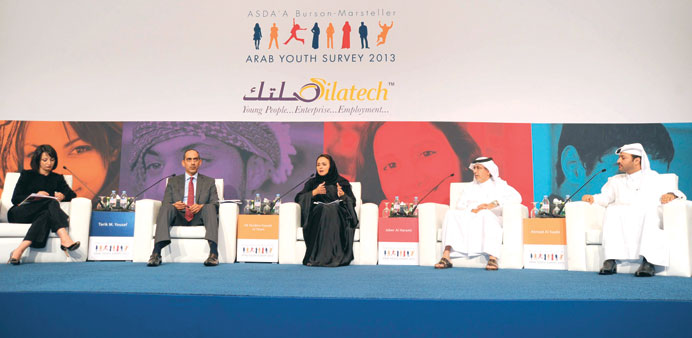
Dignitaries discussing the implications of the survey findings.