


The Egyptian Supreme Council of the Armed Forces (Scaf) is still very much in power and if it wants it could alter the government in Egypt, a Brookings Doha Centre (DBC) policy discussion was told yesterday .

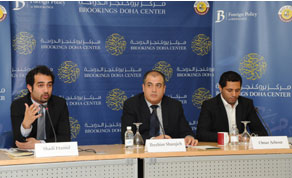
Sharqieh flanked by Hamid and Ashour yesterday at the DBC discussion
Scaf has retained considerable powers through the complementary constitutional declaration devised recently. It can also manipulate power through a few constitutional tools and courses including the verdicts of the Supreme Constitutional Court. However, the use of oppressive means to alter the scale of power by Scaf is alienated.
The discussion that took place yesterday adopted the topic “End of transition or end of revolution: Where now for Egypt?” The speakers were Omar Ashour, a visiting fellow DBC, lecturer in politics and director of the Middle East graduate studies programme at the University of Exeter, Shadi Hamid, DBC director of research, and Khalid Elgindy, visiting fellow, Foreign Policy at Saban Centre for Middle East.
Elgindy was speaking from US through the Internet. The discussion was moderated by Ibrahim Sharqieh from DBC.
Ashour explained the ruling powers in Egypt had experienced defeat on three stages: the success of the revolution, the Muslim Brotherhood winning the majority of seats in the parliamentary elections and through the presidential elections.
Hamid pointed out the new president of Egypt had come stripped of many powers, yet he still retains the symbolic importance of the office. He argued that Mohamed Mursi, the new Egyptian president, does not have overwhelming or impressive characteristics that could help him manage the situation. Hamid described him as having been mostly a man of an organisation with deep rooted loyalty to the Muslim Brotherhood. Yet, should he rise to the occasion and adapt to the consequences of his position, he would be able to contain the difficult situation ahead.
Hamid said that revolutionary forces in Egypt wanted to avoid the rise of Ahmed Shafiq and saw him as a suppressor of the revolution. Further, the Salafists saw in him an upcoming period of torture and oppression. Though Mursi could not unite all forces behind him he was the only viable alternative for them.
“Some supported Mursi in desperation to save the revolution,” said Elgindy, adding that to rise to the occasion, he needs a lot of humility and rise above his Muslim Brotherhood roots.
Elgindy saw that there is a very strategic partnership between Egypt and US, and the change of regime in Egypt is not genuine enough to make US worry though they have to approach the situation very cautiously. He also believes that the US influence in the region has been diminishing because of the rise of the new powers. There is also a popular culture in Egypt of anti-Americanism and anti-Zionism.
He admitted that there is a broad consensus that Egypt wants to retain peace with Israel, however on more balanced terms.
The situation with the Palestinians is quite different, according to Elgindy. While Hamas welcomed the rise of Mursi and saw it as a victory for their cause, Palestinian President Mahmoud Abbas could not welcome his rise as good news.