


A senior sustainable development expert has said it is difficult to put in place green and sustainable solutions in hotter areas, lying closer to the Equator compared to colder places nearer to the polar regions.

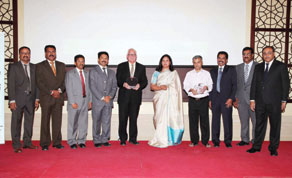
Gregory Acker (fifth left) and Raju Narayana Swamy (fourth right) with QGET officials who organised Quest 2012 summit
“Sustainability should take into account the culture of a place besides such commonly accepted criteria of environment, economy and society. These include factors like food, water, shelter, language, beliefs and historical inputs like urbanistion and communication,” said Gregory Acker, who is closely associated with the activities taking place in the Msheirib community development project in its ambitious “Heart of Doha” project.
He was making a presentation at the Quest 2012, an engineers’ summit held at the initiative of QGET, the local chapter of the Government Engineering College, Thrissur on Sunday.
The summit held at the Inter-Continental Doha Hotel attracted about 300 engineers, including members of the Qatar Engineers Society.
Acker said Qatar’s carbon emission is 49 tonnes of CO2 per person, which is the highest in the world. This is driven by three factors: it is “small”, it is “hot” (so there is extensive air-conditioning) and it is “dry” (which means hydro electric projects are impractical and entire water generation is wholly dependent on desalination).
“Compared to Qatar, there is less emission of the CO2 per person in Kuwait, which is 30 tonnes, UAE 25 tonne. 8.5 tonnes and Brazil 2 tonnes,” he said.
As an example and inspiration for engineers coming up with workable and sustainable solutions Acker singled out for praise the efforts of Kancharla Sampath Reddy, an Indian engineering student who came up a cell phone charger costing just QR8 that worked on lung movement during breathing.
While speaking about the Msheirib Properties, Acker said such projects are being developed as a model for sustainable development for not only the country, but for the entire Middle East region.
Among the visions of HH Sheikha Moza, chairperson of Msheirib Properties is to “create a sophisticated city district with vitality for the people of Doha” through sustainable urban regeneration, he said adding it is a vision of a “rising homeland that confidently embraces modernisation and proudly observing traditions.”
The speaker also described Msheirib Properties as the Middle East’s largest sustainable downtown regeneration project spanning over 77 acres mixed-use development in the heart of Doha. The state-of-art project is expected to connect the city’s past with its future.
Special care is given towards pedestrian movement throughout the development, even while it incorporates many plazas and squares for the public, he said.
The development features more than 60 buildings, one school, three mosques and 32 townhouses all of which will conform to reputable and globally acclaimed building standards.
Some of the sustainability elements incorporated in the Msheirib project are solar shading of streets and reduced heat gain in buildings, natural ventilation, solar electric panels and solar water heating, water saving landscaping including the use of municipal non-potable water, and neighbourhood and building waste management systems.
Natural shading is obtained by placing buildings closer to one another with pedestrian walkways between them. All parking is planned to be underground, thus allowing for the buildings to be close to one another.
Before winding up his informative presentation, Acker emphasised that society can never really throw things “away” because “away” is never too far.
“It is our duty to think about our children and their children.”
Earlier Indian Administrative Service official and Kerala state’s Commissioner of Civil Supplies Raju Narayana Swamy highlighted the importance of developing effective community-based disaster risk management systems across the world.