


By Clyde Russell, Reuters
Brisbane
It seems that virtually everybody involved in Australia’s liquefied natural gas boom is convinced that it’s coming to a sticky end and the country risks losing out on a second phase of investment worth more than $100bn.
It also seems that everybody knows where to point the blame, with escalating costs in the form of excessive wage claims and government red and green tape being the culprits-in-chief.
But many of the solutions presented at the annual gathering of the Australian Petroleum Production and Exploration Association this week seem unlikely to make much difference, or even if they would, there are serious doubts about whether they can be implemented.
A much-used phrase at the industry’s jamboree was that the “window of opportunity” to expand the LNG sector is closing.
The industry’s main fear is that gas exports from the US and Canada, as well as new projects being planned off Africa’s east coast will deliver LNG at cheaper prices to customers in Asia.
Australia currently has seven LNG projects under construction, with a total estimated investment of close to $200bn.
These projects alone will make the nation the world’s largest exporter of the super-chilled fuel, overtaking current leader Qatar.
The problem comes for the five ventures still to reach a final investment decision, and at least six more planned expansions of existing plants.
The cost of building these projects is estimated by consultants Wood Mackenzie at 20 to 30% higher than competing ventures in East Africa and North America.
Clearly, given the global nature of capital and the fact that most of the projects are being undertaken by international oil majors, that kind of cost disadvantage will outweigh any advantages offered by Australia’s proximity to Asia and its stable political system.
The main solution industry executives and their counterparts in government appear to favour is basically speeding up the process of approvals so that the remaining Australian projects can get underway before those in the US, Canada, Mozambique and Tanzania.
The companies want faster processes from state and federal governments, something the politicians seem eager to provide.
They are also looking for government action to rein in union demands for ever higher wages, something the Liberal Party is more likely to provide than the Labor Party.
Liberal governments now rule in Queensland, New South Wales and Western Australia states and opinion polls point to a heavy defeat for the Labor-led federal government at an election scheduled for September.
But whether governments can help deliver lower wage outcomes is questionable, especially when the supply-demand balance is still heavily in favour of the workers.
It’s here where there seems to be a rupture in the logic of the industry.
In order to cut costs and beat overseas competitors, the project timelines must be accelerated.
But Australia is already struggling to build seven LNG plants simultaneously, so it seems doubtful that starting several more would do anything other than continue to drive costs higher.
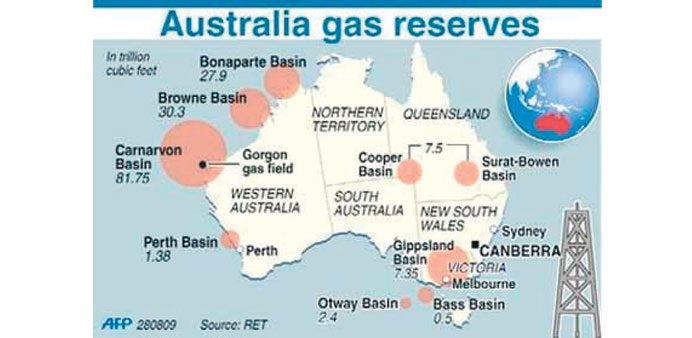
Of course, there are other options, with Woodside Petroleum, the operator of the nation’s largest LNG plant, considering a floating platform for its Browse project after scrapping plans to build onshore due to high costs.
But the main way to cut costs would be for the industry to consolidate and share more infrastructure, something that has yet to happen.
There is ongoing speculation that Royal Dutch Shell will scrap its Arrow project and seek to combine with one of the three other coal-seam gas-to-LNG projects currently under construction in Queensland state.
Publicly Shell says it remains committed to Arrow, but it has delayed taking an investment decision and the project appears to be in limbo currently.
But outside of the possibility Shell may throw in Arrow with another venture, there doesn’t seem to be moves towards consolidation, and it’s hard to see how the multitude of parties involved would be able to find enough common ground.
One notable feature of Australia’s LNG boom has been the diversity of operators it has attracted.
The coal-seam gas projects boast companies as diverse as ConocoPhillips, Malaysia’s state-owned Petronas, BG Group, PetroChina and local companies Origin Energy and Santos.
Conventional projects off Western Australia include the $50bn Gorgon LNG being led by Chevron, with minority stakes being held by Exxon Mobil and Shell.
Japan’s Inpex has partnered with France’s Total in the Ichthys project off the Northern Territory and GDF Suez has linked with Santos for a proposed floating project off the northern coast.
While not impossible, extracting meaningful cost savings through sharing infrastructure and facilities among companies that are often fierce rivals will be extremely challenging.
It seems that the future of Australia’s LNG investments would be better served by taking a longer view rather than rushing headlong to try and get all the projects up and running ahead of potential competitors.
Doing things slower will extend the life of the boom and will also help cut labour costs as the number of available workers increase as each current project is completed.
Australia is already going to become the world’s biggest LNG producer. It can afford to play the long game in further developing the sector.