


By Ramesh Mathew/Staff Reporter
Technocrat-turned Indian civil servant Raju Narayana Swamy has highlighted the importance of developing effective, flawless and practicable community-based disaster risk management systems in every community across the world.

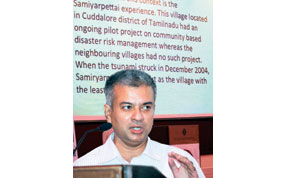
Indian Administrative Service official Raju Narayana Swamy delivering the keynote address at Quest 2012, organised by QGET at InterContinental Doha Hotel yesterday
The 1991 Civil Services topper said this while making a presentation “Sustainable development: a policy perspective for posterity” at the 1st Quest 2012, an engineers forum aimed at enhancing technical knowledge and developing a better work culture through better understanding among others.
In his presentation, which had many mind-boggling facts and figures, the versatile speaker succeeded in conveying to the gathering a regional perspective of a universally debated subject, especially when he deliberated on the necessity of developing effective disaster management systems and also developing methods to overcome the perils of water scarcity.
Swamy also called upon the developing countries to take the lead in combating climatic changes and their adverse affects.
A globally acclaimed specialist in sustainable development, backed by the experiences of his participation and presentation of work papers in more than 40 international conferences in the last two years alone, Swamy called for the implementation of better strategies everywhere to overcome natural calamities and disasters as the 2004 Tsunami, which claimed more than 230,000 lives in South and South East Asia.
“Even when the government initiatives failed to work at critical junctures as in the 2004 tsunami, some community-based disaster management programmes like those in Samyarpettai in Tamil Nadu’s Cudalloore district proved to be successful,” he said.
The disaster management system in the village was very practicable and hence the area alone managed to withstand the onslaught of the disastrous tidal waves that hit the entire Tamil Nadu coast, he recalled.
The speaker also mentioned the shortcomings and impracticability of government-led initiatives while fighting disasters and he called upon the private sector to explore the possibility of introducing innovative but practicable methods to overcome them in shortest possible time.
Certain places in Cambodia and in Dumingano municipal area in the Philippines also have similar successful community-based initiatives for disaster management, he mentioned.
Deliberating on the dwindling water resources the speaker said the per capita water consumption in several countries is expected to fall drastically by 2025.
He said recent studies have found nearly one-third of the world population, including many in India, would be living in absolute water scarcity in less than 15 years from now.
The hydro engineers need to explore more superior technologies to make maximum use of the ground water, which is by and large remaining under utilised across the world until now, he said.
The speaker also recounted how much damage is done to the eco-system in a particular area through over-exploitation of water resources as it happened in a Kerala village bordering Tamil Nadu where a multi-national soft drink giant built a plant. In less than four years, the entire area witnessed a severe drought and resultant water scarcity led to public agitation which ultimately led to the closure of the manufacturing facility.
Swamy felt generally the success of sustainable development in a society is measured only when its benefits reached maximum number of people, both the present and future generations.
“Even when the prime focus of the sustainable development is to meet the requirements of the present generation, the developers also have a responsibility to ensure that its benefits reached the future generations as well in a flawless manner,” he said.
Later sustainable management expert at Msheireb Properties’ Doha Land project Gregory Acker also spoke.
The summit was inaugurated by the South Korean Ambassador to Qatar Chung Jong Ki.
Middle East Indian Management Association president and rights activist Nizar Kochery and Institution of Engineers (India) Qatar chapter president Debashish Roy also spoke.
President of QGET, the Qatar alumni of Government Engineering College Thrissur, Mohamed Faisal welcomed the gathering and John E J introduced the speakers.