


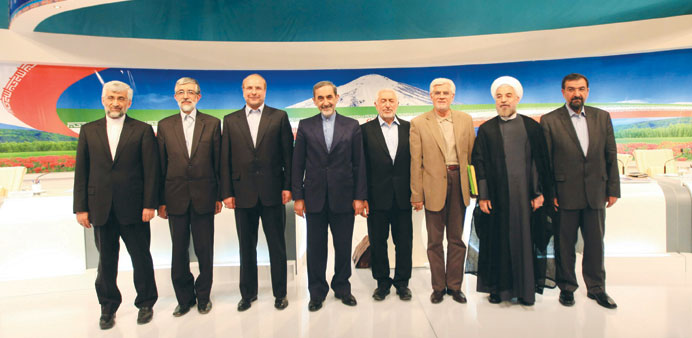
A televised debate on Iran’s sanctions-hit economy yesterday failed to introduce a frontrunner as the eight approved presidential candidates echoed each other on the main issues and refrained from making direct attacks.
The debate, the first of three organised by state television ahead of the June 14 election, lasted four hours and focused on the economic policies of the candidates.
But it gave each candidate only a short time to answer questions on an ailing economy struggling to cope with inflation, unemployment and oil revenues slashed by international sanctions.
All eight had been cleared by the hardline Guardians Council electoral oversight body which last week barred two high profile would-be candidates from standing.
Both moderate ex-president Akbar Hashemi Rafsanjani and incumbent Mahmoud Ahmadinejad’s close ally Esfandiar Rahim Mashaie were excluded.
The debate’s format, especially a multiple choice section of questions on how to run the country, prompted some criticism.
“This way of organising the debate and asking questions is an insult to all the eight candidates and the Iranian people,” said reformist Mohamed Reza Aref, refusing to answer them.
Mohsen Rezai, an ex-commander of the elite Revolutionary Guards, called the debate demeaning.
“You should have let the candidates develop their plans and ideas,” he said.
“If since the start of the campaign you do not respect the rank of president, it means that we do not want to have a strong government.”
Apart from such mild criticism, the debate failed to resonate with voters.
“Nearly all the candidates criticised the incumbent administration’s policies without giving a solution to the country’s current economic issues,” said Amir, a 31-year-old architect.
“People prefer face-to-face debates that allow candidates to challenge each other,” he added of heated one-on-one debates four years ago.
These saw heated exchanges between Ahmadinejad and his pro-reform opponents, Mir Hossein Mousavi and Mehdi Karoubi.
Those debates revitalised the 2009 presidential election, and were blamed partly for post-vote street unrest over claims of fraud when Ahmadinejad was re-elected.
Mousavi and Karoubi have been under house arrest for more than two years.
Yesterday, the candidates echoed each other on how to solve economic issues, especially in confronting international sanctions targeting Iran’s economy over its controversial nuclear ambitions.
World powers suspect a military motive for Iran’s nuclear project, a charge Tehran denies.
“The main policy of my administration will be an oil-free economy. It means the budget dependency on oil will be lowered to zero,” said Aref.
Top nuclear negotiator-turned presidential candidate Saeed Jalili said the sanctions “present an opportunity if we lower our dependency on oil”.
Supreme Leader Ayatollah Ali Khamenei, the ultimate decision maker, has urged lesser economic dependence on oil sales for the Islamic Republic.
Iranians have in recent years seen their currency the rial lose more than two-thirds of its value because of sanctions, as well government “mismanagement” in dealing with them.
Jalili, a conservative frontrunner seen close to Khamenei, said that under his presidency Iran would move to “avoid the sale of crude” and instead focus on increasing production of refined petroleum products.
Another conservative hopeful, ex-speaker of parliament Gholam Ali Haddad Adel, said Iran could compensate for “the reduction in oil export by increasing non-oil exports”.