


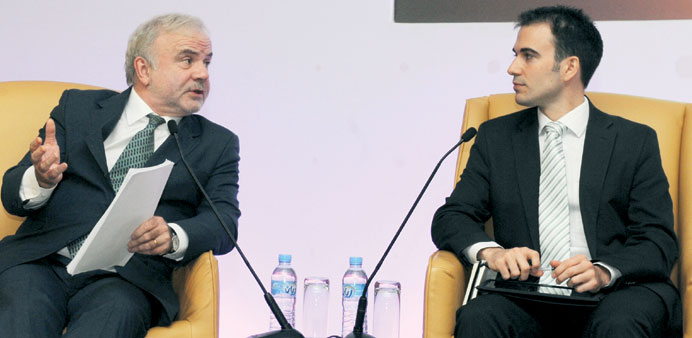
Rob Shaw (right) with MEED chairman Edmund O’Sullivan yesterday. Picture: Jayan Orma
By Ramesh Mathew/Staff Reporter
As Qatar witnesses large-scale infrastructure development, involving projects that are already under way or in the pipeline, the country’s aviation sector is expected to benefit from these and record significant growth in the next decade, according to an expert.
Rob Shaw, director of analytical studies at OAG Aviation, said three airlines in the region - Qatar Airways, Emirates and Etihad - were expected to make considerable strides in view of the rapid growth of the aviation sector in Qatar, Dubai and Abu Dhabi. He was speaking at a session on developments in the airline industry in the Middle East, held as part of Qatar Transport 2013, organised by MEED Events, which concluded yesterday. OAG Aviation is a leading aviation intelligence provider.
Highlighting the prospects for Qatar, Shaw said: “While the global aviation industry’s projected average annual growth over the next decade is around 3% and the GCC’s overall rate is about 9 %, the industry in Qatar is expected to grow at an amazing rate of 15%.” He added that Doha’s Hamad International Airport (HIA), when completed, would handle about 50mn passengers per annum.
“When the first phase of the HIA is ready, which is expected later this year, the airport will be equipped with facilities to handle about 28mn passengers per year,” said Shaw.
The speaker noted that similar growth was expected in the seating capacities of Qatar Airways, Emirates and Etihad over the next 10 years. “It is happening at a time when many traditional players in the Far East, East Asia and Europe are showing a decline and even recording negative growth in their activities,” he said, naming some of the carriers affected by global slowdown in his presentation.
“It is also good for Qatar’s aviation industry that Qatar Airways recorded 11% growth in terms of destinations last year, when airlines in Saudi Arabia, Kuwait and Bahrain withdrew from a number of routes,” he added.
The aviation analyst said the number of airline passengers globally was projected to reach 6bn in the next 15 years, while traffic to, from or through the GCC states should be close to 400mn by 2025.
According to Shaw, Qatar Airways, Emirates and Etihad have combined orders for 454 aircraft, to be delivered over the next 15 years. Of these, Qatar Airways has pending orders for 141 Airbus planes, Emirates for 129 and Etihad for 41. The three companies have also placed orders for 64, 33 and 46 Boeing aircrafts, respectively, for delivery in the next 10-12 years.
He indicated the possibility of huge growth in the operations of low-cost carriers (LCCs) in the region, notably in the UAE, Qatar and Kuwait. The growth of LCCs in the last six years has been spectacular in many places, though their penetration in this region has so far been relatively negligible when compared to the figures recorded in countries like the US.
In the US, close to 26% travellers used LCCs for their journeys last year. The corresponding figure for the UAE - which has the highest penetration in the GCC - was 16%.
“With more operators flying in the region, the figure is expected to shoot up in the next decade,” said Shaw, adding that flydubai alone carried close to 600,000 passengers last year. Impressive figures were also recorded by Air Arabia, Air India Express, Jazeera Airways and Pegasus, he noted.
Along with Doha’s new international airport, additional facilities being developed at Dubai International Airport will help the region handle close to 160mn passengers by 2020. Similarly, the Abu Dhabi Airport, which caters to nearly 10.8mn passengers at present, will be equipped to handle between 27mn and 40mn passengers in another 10 years.
Another major development is the ongoing expansion in Istanbul, where the new airport will handle close to 150mn passengers per annum by 2020, said Shaw.